


Less Tech Noise. More Strategic Insights
Join 5000+ Tech leaders & CISOs receiving our deep-dive insights.
Building a Strong IT Pipeline in Canada: Solving The Tech Talent Shortage


If your last IT requisition sat open for more than 60 days, you’re not alone.
Across Canada, IT managers are juggling multiple open roles while delivery timelines slip and internal teams are stretched thin. A DevOps engineer leaves. A new cloud migration project starts. Suddenly, three roles are open, recruiters are scrambling, and the team already working overtime is asked to “hold things together” until new hires arrive.
The challenge isn’t isolated to one company or sector. According to ManpowerGroup and Robert Half Canada hiring reports, more than 90% of Canadian tech leaders say the tech talent shortage is affecting their ability to deliver projects on time. Meanwhile, the average time-to-fill for specialized IT roles now regularly exceeds 60–90 days.
But the companies solving this problem aren’t simply getting lucky in the hiring market.
They’re operating under a different hiring model — one built around a proactive IT staffing pipeline rather than reactive hiring.
Why IT Hiring in Canada Keeps Failing
Most Canadian companies assume the problem is simple: there aren’t enough qualified developers available.
The reality is more complicated. The real issue isn’t just the tech talent shortage in Canada; it’s how most organizations approach hiring.
Three structural problems keep Canadian IT hiring slow, expensive, and unpredictable.
1. Reactive Hiring
Most organizations open a requisition only when a developer resigns or a new project suddenly requires additional capacity.
By the time hiring starts, the business is already behind schedule.
With Canadian IT roles often taking 60–90 days to fill, reactive hiring inevitably leads to delivery delays. Instead of planning ahead, companies begin searching only after the problem already exists.
2. Competing for the Same Talent Pool
Many hiring teams rely on job boards as their primary sourcing channel.
The problem? Job boards only capture active candidates.
But research across the Canadian tech labour market consistently shows that 75% or more qualified IT professionals are passive candidates, people who are open to opportunities but not actively applying for jobs.
That means thousands of companies are competing over the same small slice of visible talent while ignoring the larger, harder-to-reach pool.
3. Vetting Without Technical Depth
Even when resumes start coming in, the evaluation process often slows everything down.
Hiring managers might review 80 or more CVs for a DevOps or cloud engineering role, trying to evaluate technical experience they may not personally specialize in.
Job boards optimize for volume, not fit. Each poor-fit interview can consume 3–4 hours of senior engineer time, pulling key contributors away from product development and delivery.
The companies solving these challenges aren’t relying on luck in the hiring market.
They’ve shifted from reactive recruiting to a much more strategic approach: a proactive IT staffing pipeline.
What a Strong IT Talent Pipeline Looks Like for Canadian Companies
A talent pipeline is simply a structured system for identifying, engaging, and maintaining relationships with potential candidates before a job opening even exists.
Instead of starting from scratch every time a role opens, companies already have access to pre-vetted candidates familiar with their organization.
The difference between reactive hiring and a pipeline model becomes clear when you compare the two approaches.
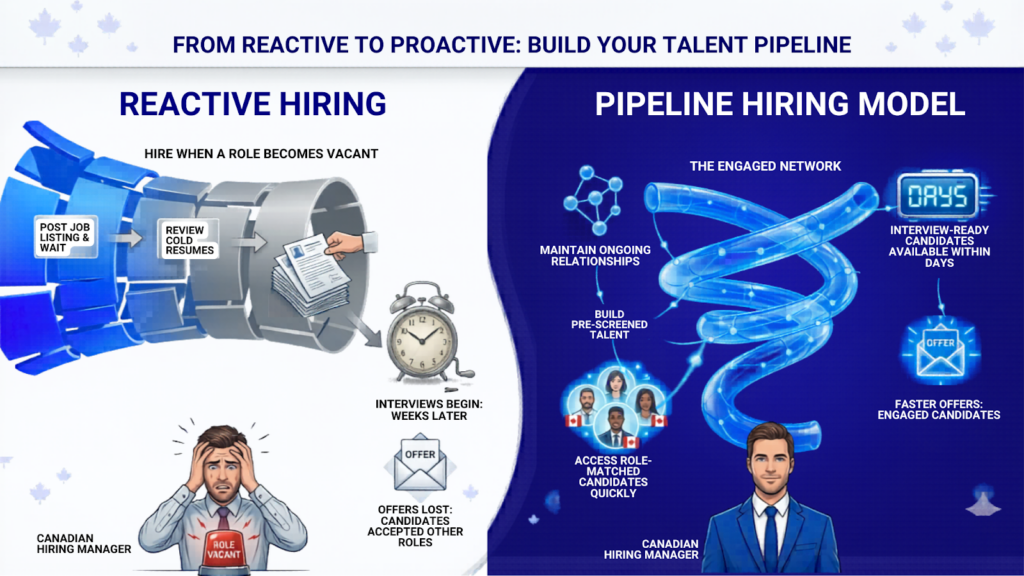
In the reactive model, hiring starts when the problem appears.
In the pipeline model, hiring is continuous preparation.
For Canadian companies navigating the tech talent shortage, this shift toward proactive workforce planning is becoming a competitive advantage.
The 3-Part Framework for Building a Reliable IT Staffing Pipeline in Canada
A strong IT staffing pipeline doesn’t happen by accident.
The most effective hiring teams build it intentionally through three key practices.
Pillar 1: Stop Fishing in One Pond and Start Using Multi-Channel IT Sourcing
Job boards represent only a small portion of the available talent market.
To reach the best candidates, Canadian companies need multiple sourcing channels working together.
Effective IT talent pipelines typically include:
- LinkedIn Recruiter and targeted InMail outreach to reach passive candidates
- University and co-op partnerships with institutions such as the University of Waterloo, UBC, McGill, and Toronto Metropolitan University
- Employee referral programs with structured incentives
- Participation in developer communities like GitHub, Stack Overflow, and local tech meetups
- Access to staffing agencies with pre-built networks of vetted IT professionals
The strongest IT pipelines in Canada aren’t just posted — they’re cultivated.
The best candidates rarely apply to job postings. They’re discovered through relationships built before they start searching.
Pillar 2: Define What “Good” Looks Like Before Opening the Role
Another major cause of hiring delays is unclear evaluation criteria.
Many teams define requirements only after resumes begin arriving.
A pipeline-driven hiring strategy fixes this by establishing hiring criteria early.
Strong IT hiring frameworks include:
- A skills matrix separating must-have skills from nice-to-have capabilities
- Pre-defined technical assessments or coding tests
- Agreed interview panel members and availability windows
- Internal hiring SLAs (for example, first interview within 5 days)
- Approved compensation ranges before the first candidate conversation
When hiring criteria are standardized upfront, organizations can move significantly faster without sacrificing quality.
→ If your team doesn’t have the time or internal resources to build this infrastructure, a specialized IT staffing partner can often provide both the framework and the candidates.
Speed at the beginning of the funnel means little if candidates wait weeks for interviews. Structured vetting processes protect both time-to-offer and candidate experience.
Pillar 3: Match the Hiring Model to the Role
Not every IT role requires a permanent hire.
Many Canadian organizations are increasingly blending permanent and contract talent models to increase flexibility and reduce hiring risk.
Common hiring models include:
1. Staff Augmentation
Ideal for short-term or project-based needs. Contractors provide specialized skills quickly without long-term commitments.
2. Contract-to-Hire
Companies bring in a contractor with the option to convert them to a permanent role after evaluating performance and cultural fit.
3. Permanent Hiring
Best suited for core roles that require deep institutional knowledge, such as architecture, platform ownership, or leadership positions.
4. Recruitment Process Outsourcing (RPO)
Organizations with large hiring plans may partner with a staffing firm to manage recruitment operations at scale.

Canadian employers should also pay attention to contractor compliance considerations such as CRA classification rules, WSIB obligations, and proper payroll handling.
According to a market research, more than 50% of Canadian tech managers plan to expand their use of contract talent in 2025 to maintain delivery flexibility.
The most resilient IT teams now operate with a hybrid workforce model: a permanent core team supported by flexible contract specialists.
The Hardest IT Roles to Fill in Canada Right Now
While demand for tech talent is high across the board, certain roles consistently prove harder to fill.
1. Cybersecurity Specialists
Cloud security engineers, SOC analysts, and SIEM specialists remain among the most difficult roles to hire. Increasing regulatory pressure across financial services, healthcare, and government is outpacing supply.
2. AI and Machine Learning Engineers
The explosive growth of AI adoption has created one of the largest talent gaps in the Canadian technology workforce. Demand for AI/ML engineers significantly exceeds the available talent pool.
3. Cloud Architects and DevOps Engineers
Organizations migrating infrastructure to AWS, Azure, and Google Cloud require specialized engineers capable of designing scalable systems. Platform-specific expertise further fragments the candidate pool.
4. Senior Software Developers
Full-stack developers remain foundational to nearly every technology organization. While more developers exist in this category than in other roles, the sheer volume of open positions keeps demand high.
5. Data Engineers and Data Scientists
As companies modernize analytics infrastructure and invest in AI-driven insights, data engineering and data science roles are becoming increasingly strategic.
6. IT Project Managers and Business Analysts
Hybrid technical-business roles often go overlooked in talent discussions, but these positions play a critical role in aligning technical execution with business strategy.
Should You Build This Pipeline In-House or Partner With an IT Staffing Agency?
Some organizations successfully build internal talent pipelines.
But that approach only works under specific conditions.
When Building In-House Makes Sense
Companies can manage hiring internally when:
- They have a dedicated technical talent acquisition team
- Hiring volume is relatively low (1–3 IT roles annually)
- They have 6–12 months to build a passive candidate network
- Their compensation packages are competitive with the broader market
For many organizations, however, internal pipelines struggle to scale quickly.
Four Signals It’s Time to Bring in an IT Staffing Partner
1. Roles remain open for 60+ days
At this point, hiring delays become a business problem rather than just an HR metric.
2. Resume volume is high, but quality is low
Receiving 80 resumes but only two viable candidates indicates issues with the sourcing channel.
3. Hiring for unfamiliar technologies
Emerging areas such as AI, cloud security, and advanced DevOps require specialized technical screening.
4. Rapid hiring growth is required
Organizations scaling quickly may need multiple hires within a compressed timeframe.
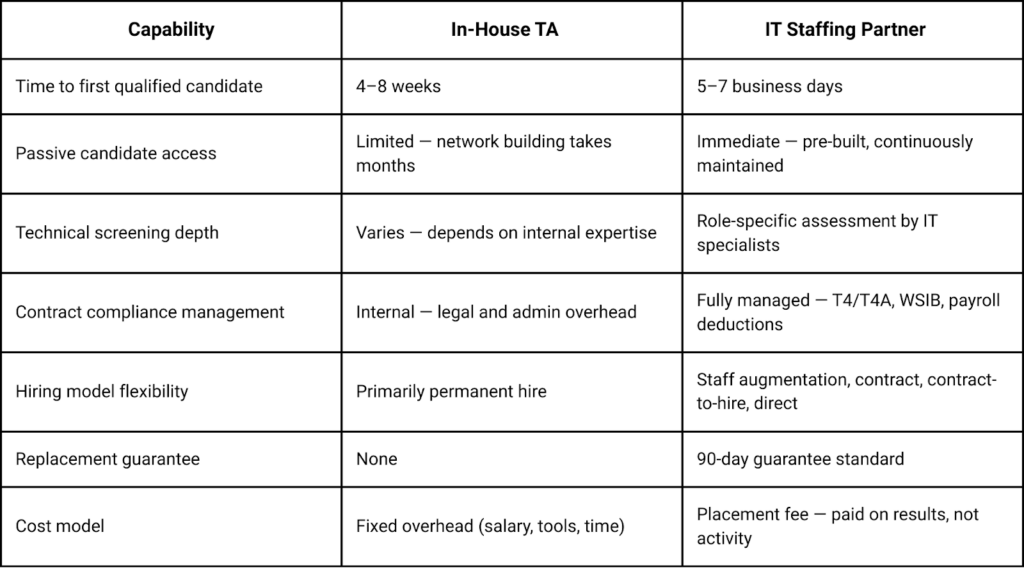
Before choosing a staffing partner, Canadian companies should evaluate agencies across several key criteria. Use the IT staffing agency evaluation checklist below when comparing vendors.
Understanding the Canadian IT Talent Landscape in 2026
Several labour market trends continue shaping Canada’s IT hiring environment.
- Canada’s tech workforce continues to expand, yet demand for specialized roles still outpaces supply.
- Robert Half Canada salary reports show sustained salary growth across cloud engineering, cybersecurity, and AI roles.
- ManpowerGroup employment outlook surveys consistently rank technology as one of the most difficult sectors to hire for.
- Rapid digital transformation initiatives across banking, healthcare, and manufacturing continue increasing demand for developers and cloud specialists.
The Canadian government’s Global Talent Stream immigration program also provides an important pathway for companies struggling to fill highly specialized roles domestically.
Through this program, employers can bring qualified international technology professionals into Canada with significantly accelerated visa processing.
Building a Strong IT Hiring Pipeline Starts With the Right Strategy
The companies that will win the talent competition in Canada over the next decade won’t simply be the ones offering the highest salaries.
They’ll be the organizations that move from reactive hiring to proactive talent pipeline strategies.
Building that pipeline takes time, infrastructure, and access to talent networks that many internal teams simply don’t have the bandwidth to build on their own.
That’s exactly what specialized IT staffing partners are built for.
Talk to our IT staffing experts in Canada and start building your IT talent pipeline today.
Frequently Asked Questions
Most IT staffing agencies in Canada can present qualified candidates within 5–7 business days, although final hiring timelines depend on interview availability and decision speed. Compared with traditional hiring processes that can take 60–90 days, staffing partners often significantly reduce time-to-hire.
Staff augmentation provides temporary professionals who work directly with your internal team, while outsourcing transfers responsibility for delivering a specific project or service to an external provider. Staff augmentation offers more control and flexibility.
Look for agencies that specialize in IT recruiting, conduct technical pre-screening, maintain passive candidate networks, and provide transparent metrics such as time-to-fill and retention rates.
For organizations facing tight delivery deadlines or specialized hiring needs, staffing agencies can significantly reduce hiring timelines and access talent that may not be available through traditional recruiting channels.
Cybersecurity specialists, AI engineers, cloud architects, DevOps engineers, and data engineers remain among the most difficult positions to fill due to rapid demand growth and limited talent supply.
Yes. Many startups use staffing agencies to quickly access experienced engineers without building a full internal recruitment team, particularly during rapid product development phases.