


Less Tech Noise. More Strategic Insights
Join 5000+ Tech leaders & CISOs receiving our deep-dive insights.
Holiday Rush? How AI Saves Customer Support Teams in December Chaos


-
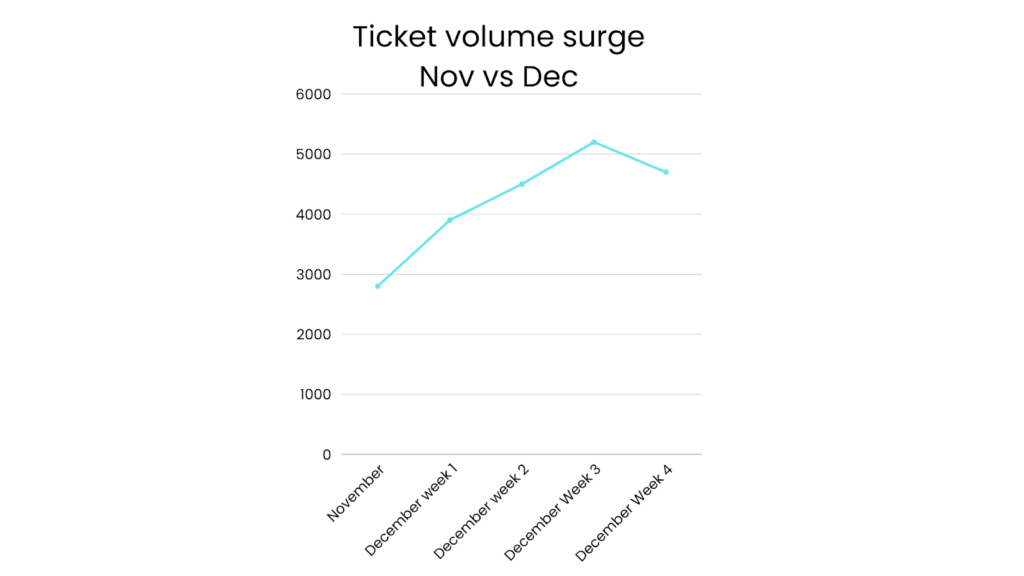
December doesn’t just increase customer demand — it exposes every weakness in your support system.
Ticket volumes jump 200–400%.
Average response time doubles.
Customer patience drops to 30 seconds on chat.Support teams aren’t just “busy” — they’re swamped and pushed to the limit. As one CX leader puts it, “We don’t have bad agents — we have bad capacity planning.” When requests spike and tempers flare, manual processes break down first, and customers notice it right away. This can either protect or harm a brand’s reputation.
Infosprint Technologies has seen this pattern across every CX operation we’ve supported — AI isn’t a trend anymore; it’s essential to maintain stability under extreme pressure. This blog explains how AI transforms December chaos into predictable, scalable support workflows. If your team had a tough time in previous years, what you do next decides whether next December looks any different.

Support teams face a 40–80% ticket volume spike every December, making manual workflows collapse under pressure
Why December Breaks Support Teams
The holiday season amplifies every weakness in customer operations:
- New customers flood in, bringing more questions
- Shipping delays create frustration.
- Returns and refunds spike
- Emotional intensity rises — customers expect instant answers.
- Support teams are understaffed or working overtime.
Even well-run teams struggle under sudden, unpredictable volume. And no matter how talented your agents are, manual processes simply can’t scale to this kind of pressure.
Where Traditional Support Fails Under Extreme Volume
Most support systems aren’t designed for sudden surges. The most significant breaking points include:

- Manual triage slows down everything: Agents spend minutes (not seconds) labeling, prioritizing, and routing tickets.
- Too many repetitive questions: “Where’s my order?” and “How do I return this?” consume over half of support volume.
- Context switching creates errors: Agents juggle multiple channels and dozens of tabs, leading to slower responses.
- Lack of real-time prioritization: Urgent issues get buried, while non-critical tickets flood the queue.
- Inconsistent responses erode brand trust: Under pressure, quality declines — customers notice.
Five Ways AI Turns December Chaos Into a Smooth Operation
1. AI Triage That Cuts First Response Time by 70–90%
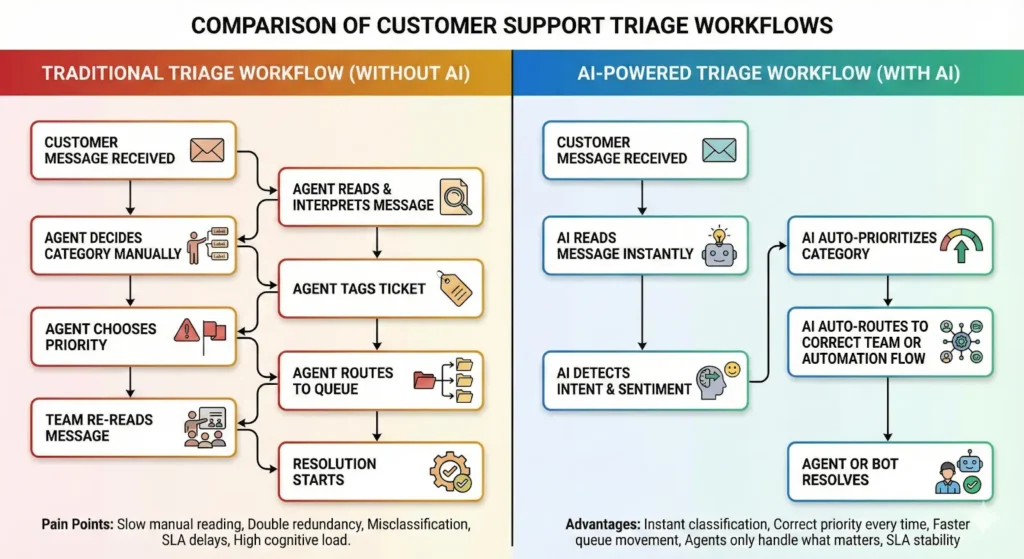
When thousands of tickets hit your system in a short window, the biggest bottleneck isn’t the reply — it’s the sorting. Traditionally, agents spend valuable time reading messages, tagging issues, determining priorities, and routing cases. Under peak-load conditions, this alone causes hours-long delays.
What AI does differently:
- Reads the customer message instantly
- Determines intent (refund, delay, product info, cancellation, etc.)
- Identifies urgency (angry tone, critical issue, VIP customer, time-sensitive requests)
- Detects the correct category
- Automatically routes the ticket to the correct queue, team, or agent.
For teams aiming to automate workflows at scale, Infosprint’s UiPath-based automation solutions can streamline routing, triage, and repetitive decision-making across the support stack.
Why this matters in December:
- High-priority issues (failed delivery, cancellations) never get buried
- Agents don’t waste time on manual sorting.
- Response times drop dramatically — often within seconds.
- Reduce backlog & improve SLA performance.
- Avoid operational choke points.
- Prevent negative reviews caused by delay.s
AI triage provides structure when volume spikes destroy it.
2. Automated Handling of 60% of Repetitive Tickets
During December, more than half of customer messages revolved around a predictable set of inquiries:
- “Where is my order?”
- “How do I return this?”
- “I typed the wrong address.”
- “Do you offer gift wrap?”
- “Can you resend my confirmation email?”
Using human agents to answer these repetitive questions is expensive—and unnecessary.
What AI does:
- Automatically detects repetitive queries
- Pulls data from order systems or CRM
- Generates clear, accurate, contextual responses instantly
- Handles entire conversations without human involvement
Benefits:
- Reduces manual workload
- Agents focus on high-value, high-empathy cases.
- Customers get instant resolutions.
- AI-driven personalization in customer experience
When your team is overwhelmed, even saving 10 seconds per ticket adds up. AI saves minutes at scale.
Example:
If AI handles 1,000 repetitive tickets a day, that’s the equivalent of having 5–10 additional agents working full-time — without hiring.
3. AI-Assisted Replies for Human Agents (The Superpower Layer)
Not every ticket can or should be automated. High-emotion cases still require human empathy.
But AI dramatically accelerates human performance by acting as a real-time assistant.
What AI assist tools can do:
- Draft complete, personalized responses in your brand voice
- Detect customer sentiment and recommend tone adjustments.
- Summarize long message threads so agents don’t waste time reading.
- Suggest the following best actions based on previous resolutions.
- Auto-fill required data from CRM or order systems.
Result:
Agents save 60 seconds per reply — multiplied by thousands of conversations.
Why this matters in December:
- Your team is tired, stressed, and racing the clock. AI reduces cognitive load, allowing them to focus on what humans do best—empathy, judgment, and problem-solving.
- Improved consistency and reduced errors
- Higher throughput per agent
- Faster replies = fewer abandoned carts
AI doesn’t replace agents. It amplifies them. Human + AI collaboration in customer experience is the future of retail customer engagement.
4. Real-Time Workload Balancing to Keep SLAs Intact
Support volume in December is unstable. There are sudden spikes based on:
- Flash sales
- Checkout bugs
- Shipping delays
- Delivery failures
- Social media virality
If you rely only on humans to rebalance workloads, it’s too slow.
What AI does:
- Predicts surge patterns based on real-time and historical data
- Highlights queues that need help
- Automatically reallocates resources (bots, agents, or workflows)
- Suggests staffing adjustments or re-prioritization
Why this matters in December:
- Your team can’t afford disorder. AI helps you move from reactive firefighting to proactive control.
- It improves throughput and efficiency
- Prevent agent burnout
- Faster issue resolution → fewer cancellations
Real-time visibility + automation = operational resilience.
5. Proactive Customer Alerts That Prevent Tickets Before They Happen
The best way to reduce support volume is to solve a problem before the customer asks about it.
AI detects early patterns such as:
- Delivery delays
- System downtime
- Product issues
- Payment failures
- Out-of-stock surges
And triggers proactive communication through:
- Email, SMS, In-app notifications, WhatsApp, and using AI conversation flows to reduce cart abandonment
Examples:
- “Your package is running late — here’s your updated delivery date.”
- “We’ve automatically processed your refund for the damaged item.”
- “Your order is ready for pickup — no need to contact support.”
Why it works:
- Proactive communication can reduce total ticket volume by 35% during peak weeks.
- Fewer repetitive inquiries
- Lower operational impact from predictable delays
- Build trust and reduce negative reviews
Proactive support transforms customer frustration into customer confidence.
What Companies See After Adding AI
Across industries, teams report:
- 60% reduction in repetitive tickets handled manually
- 70% faster first response time thanks to AI triage
- 50% improvement in overall resolution time
- 20% fewer escalations due to consistency
- Significant cost savings from reduced overtime & improved productivity
These aren’t theoretical benefits — this is what real support environments experience when AI moves from concept to practice.
Real example: tado°, a smart-home climate brand, moved to Intercom’s platform and combined automated routing, bots, and agent-assist tools — and reported a 92% decrease in first-response time with a 19% improvement in SLA performance after implementation. This shows how automation and AI at the platform layer convert volume into a predictable service.
Another brand reporting: Brands using conversational AI report similarly significant wins — Loop reduced manual effort and boosted CSAT to about 80% with Ada. In comparison, Woolacombe Bay saw an approximate 70% reduction in average resolution time using Freshworks’ AI features. These case studies demonstrate repeatable operational gains across industries.
Deploying AI Before Peak Volume Hits
You don’t need a long implementation cycle. Start with these essentials:
1. Identify your top 5–8 repetitive ticket categories
Order issues, returns, login issues, account changes, product info, etc.
2. Build automated responses & workflows for these categories
Cover the 50–60% that don’t require human empathy.
3. Integrate AI triage into your ticketing platform
Zendesk, Freshdesk, and Intercom — AI plugs in easily.
4. Train AI models on last year’s historical tickets
The system learns your patterns, tone, and policies.
5. Enable proactive customer updates
Send alerts before customers ask.
6. Turn on AI-powered agent assist tools
Reduce typing time, eliminate manual context gathering, and ensure consistent tone.
This playbook alone can stabilize a support team under any seasonal pressure.
Mistakes Companies Make (And How to Avoid Them)
- Deploying AI too late, then expecting it to fix everything
- Skipping training data, leading to generic, off-brand responses
- Over-automating, some cases still require human care
- No escalation rules, customers get stuck.
- Not monitoring performance, AI isn’t “set and forget.”
Success comes from balance: automate what’s repetitive, support humans where empathy matters.
What This Means for 2025 and Beyond
December exposes operational weaknesses, but AI provides the structure and scale to address them. If your support team struggled this year, now is the time to prepare — not when the next surge arrives.
Customer expectations won’t go backward.
- Volume will rise
- Response time expectations will shrink.
- Support complexity will increase.
AI won’t replace support teams — it will reshape them.
Teams that adopt AI early will operate with stability, predictability, and speed.
Teams that don’t will face the same December chaos every year.Want to see how AI fits into your support workflows? Get a free Support Workflow Audit and identify quick wins you can implement immediately.
Frequently Asked Questions
How can AI help my support team handle a sudden surge of tickets in December?AI automates triage, prioritization, and repetitive inquiries—reducing manual workload by 40–60%. It routes urgent cases instantly and prevents backlog buildup by resolving simple tickets before they reach agents.
What types of support tickets are easiest to automate with AI during holiday season?Order status checks, returns/refund queries, shipping delays, account updates, and basic product questions are highly repetitive. These categories can be automated immediately with high accuracy.
How fast can AI improve first-response times during peak support periods?Most teams see a reduction from hours to minutes once AI triage and automated replies are enabled. Even partial automation can improve first-response time by 70–90%, especially during high-volume weeks.
Do I need a large support team or technical resources to implement AI for holiday readiness?No. Modern AI solutions integrate directly into your existing helpdesk (Zendesk, Freshdesk, Intercom). You only need to map your top repetitive tickets, provide past ticket data, and define escalation rules.
What should my support team prepare before deploying AI for the holiday rush?Identify your highest-volume ticket categories, gather previous holiday ticket data, set clear automation rules, prepare proactive communication templates, and decide which cases must always escalate to humans.
- New customers flood in, bringing more questions
Related Blogs
Top 5 Cloud Moves That Paid Off in 2025 (and what to repeat in 2026)
Holiday Payment Fraud: Weak Links in APIs & Gateways