

Less Tech Noise. More Strategic Insights
Join 5000+ Tech leaders & CISOs receiving our deep-dive insights.
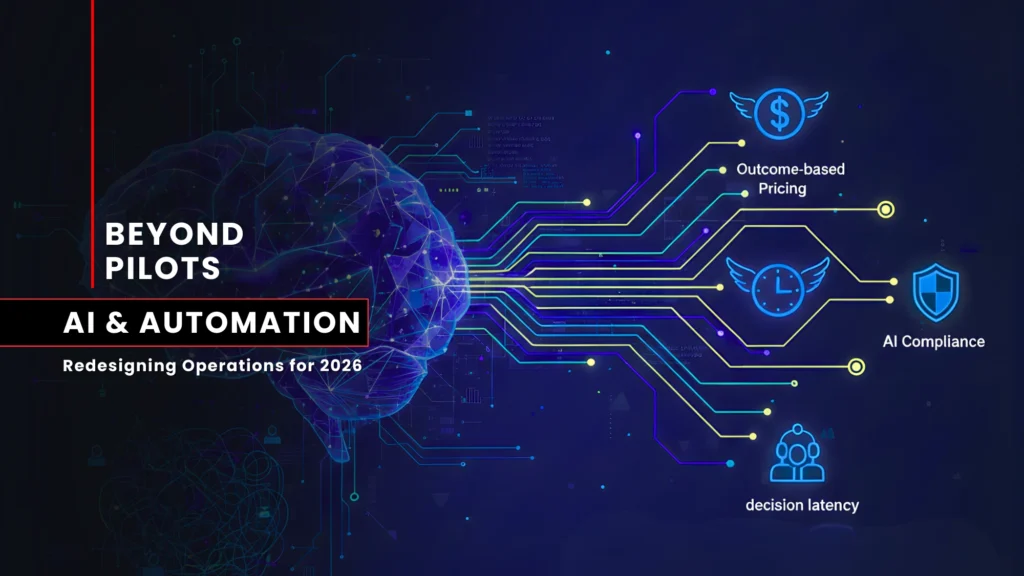
Emerging AI & Automation Trends Shaping Business Operations in 2026


- AI-Native Firms Are Resetting Competitive Expectations
- The Real Cost of AI And the Hidden Cost of Doing Nothing
- The Shift From Task Automation to Autonomous Execution
- AI Compliance in 2026: The Regulatory Reality Businesses Can’t Ignore
- The Five Highest-ROI Automation Starting Points for SMBs
- Start With an AI & Automation Readiness Assessment
- FAQs
AI adoption is no longer experimental — it’s already operational.
89% of small businesses are using AI today, and 91% report revenue growth from it. Yet only 1% of U.S. companies have scaled AI beyond pilot phases. As an industry analyst recently mentioned:
“Most organizations aren’t failing at AI, they’re failing at redesigning work.”
That’s the hidden gap shaping 2026.
The real pressure isn’t learning AI, it’s watching competitors move faster because their execution layer is changing. Teams are deploying copilots and automations, yet still operating with legacy decision cycles, fragmented data, and manual escalation points.
At Infosprint, we see this shift every day: the real divide is no longer between AI adopters and non-adopters, it’s between businesses running isolated automations and those engineering AI-native operations. And that distinction is quickly becoming the new competitive boundary.
1. AI-Native Firms Are Resetting Competitive Expectations
The competitive threat in 2026 is no longer large enterprises with bigger budgets.
It is AI-native startups architected from day one around automation-first execution.
These companies are not “adding AI.”
They are replacing human coordination layers with AI-driven orchestration.
1.1 What Makes an AI-Native Company Structurally Different?
- Continuous Deployment via AI-Generated Code
AI-assisted coding (Copilot-style workflows, automated test generation, autonomous bug detection) enables weekly or even daily release cycles. - Outcome-Based Pricing Models
Instead of per-seat SaaS pricing:
- Pay per resolved support ticket
- Pay per invoice processed
- Pay per automated claim approved
- This directly ties automation efficiency to customer ROI.
Earlier generations of automation focused on tasks:
- Extracting data
- Moving files
- Updating systems
AI-native competitors automate decisions.
Instead of flagging invoices, they validate them.
Instead of collecting support tickets, they triage them.
Instead of generating reports, they interpret them.
This shift dramatically reduces decision latency — and that speed becomes a competitive advantage.
This creates a compounding efficiency gap.
1.2. The Productivity Gap Is Now Measurable
Hyperautomation adopters are reporting:
- 42% faster process execution
- 25% productivity gains
- 1.6x higher productivity growth when AI + humans collaborate
But here’s what matters architecturally: This gap compounds.
If your competitor automates:
- Tier-1 support
- Invoice validation
- CRM updates
- Marketing performance reporting
They don’t just reduce cost, they reduce decision latency.
In 2026, the speed of internal decision cycles is becoming a primary competitive advantage.
PwC says: The businesses winning in 2026 didn’t install AI. They rebuilt operations around it.
2. The Real Cost of AI And the Hidden Cost of Doing Nothing
The most common reason SMB owners give for not moving faster on AI is cost uncertainty. They don’t know what they’re going to spend, they can’t predict what they’ll get back, and they’re drowning in vendor pitches that promise transformation but don’t specify terms. That uncertainty is legitimate — and solvable.
2.1 What SMBs Are Actually Spending and Saving:
- $500 – $2k monthly cost savings reported by AI-using SMBs
- 20+ hrs per month reclaimed from repetitive tasks
- $3.70 average return per $1 invested in generative AI
The $4.20 return per $1 invested is not a projection. It’s IDC’s analysis of actual reported outcomes from GenAI deployments in 2025. The headline numbers are real — but they come with an important qualifier: these outcomes only materialize for businesses that implement intentionally, with a clear workflow problem they’re solving. Signing up for a tool and calling it a strategy produces the sub-5% revenue gains.
2.2 Why SMBs Are Stalling With Data?
If the ROI data is that compelling, why aren’t more SMBs moving faster? The research is unusually consistent on this. The barriers aren’t primarily financial — they’re structural and psychological:
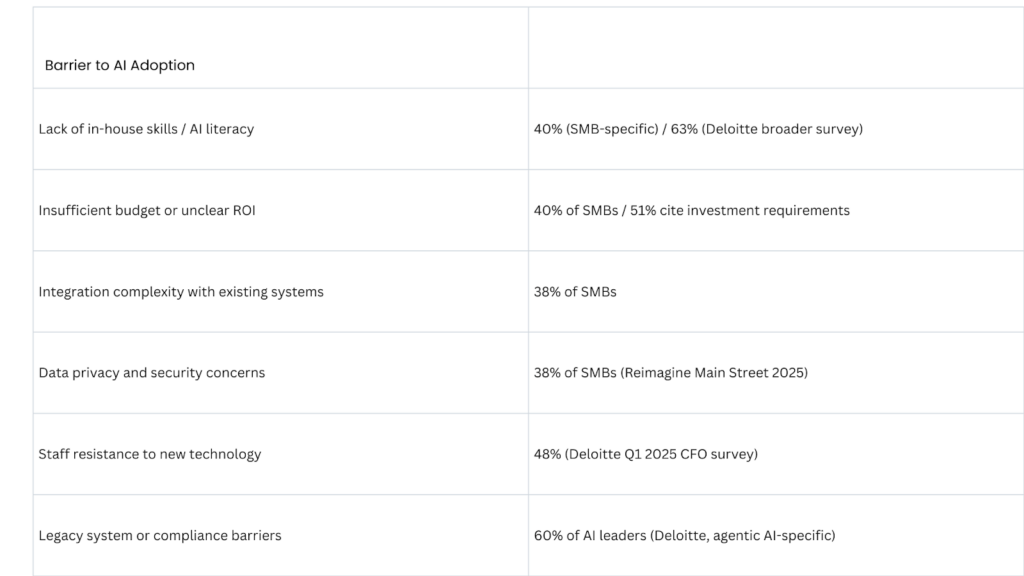
- Most SMBs don’t have someone on staff who can evaluate AI tools, run a pilot, and connect results back to business metrics.
- Second, staff resistance is remarkably high, and automation initiatives fail at the cultural level more often than the technical level
- 60% of businesses already using AI cite legacy system compatibility as a barrier to going further
2.3 The New Pricing Model That Changes the Math
One of the most significant structural changes in 2026 is how AI software is being priced. And it changes the ROI conversation in ways that directly benefit cost-conscious small businesses.
- Pay per resolved customer support ticket — not per user who has access to the platform
- Pay per processed invoice — not per employee in your accounts payable team
- Pay per qualified lead generated — a spend line you can justify against pipeline value
This model clarifies costs: $1,000 for 500 tickets at $2 each allows easy comparison to human support team expenses, shifting the focus from justifying a $50,000 annual SaaS contract.
IDC predicts that by 2026, cloud marketplaces such as AWS, Azure, and Google Cloud will be the primary way SMBs discover, evaluate, and deploy AI. These platforms provide pre-vetted tools, consumption-based billing, and compliance credentials, easing entry.
2.4 Low-Code and No-Code Automation
For SMBs without an in-house technology team, the most practical pathway into automation in 2026 is low-code and no-code platforms. Gartner and IDC both identify this as the primary entry point for small businesses, and the adoption data supports it. In a February 2026 SMB survey:
- 55% of SMBs are already automating market research tasks
- 55% have automated scheduling and calendar management
- Document classification, customer support routing, and data entry are the next tier of adoption
These aren’t sophisticated AI deployments. They’re structured starting points for workflows where inputs are consistent, outputs are measurable, and the cost of a mistake is low. That’s exactly where automation ROI is easiest to demonstrate, which makes it the right place to build internal confidence before expanding scope.
3. The Shift From Task Automation to Autonomous Execution
3.1 Agentic AI: The Evolution Beyond Rule-Based Automation
Traditional RPA systems — such as those used in modern UiPath RPA automation solutions excelled at structured tasks.
They followed rules and required stable inputs.
Agentic AI introduces a new paradigm:
Goal-driven automation.
Rather than executing predefined scripts, modern AI agents can:
- Understand objectives
- Plan multi-step workflows
- Adapt to changing inputs
- Escalate intelligently when required
This transforms automation from task execution into workflow orchestration.
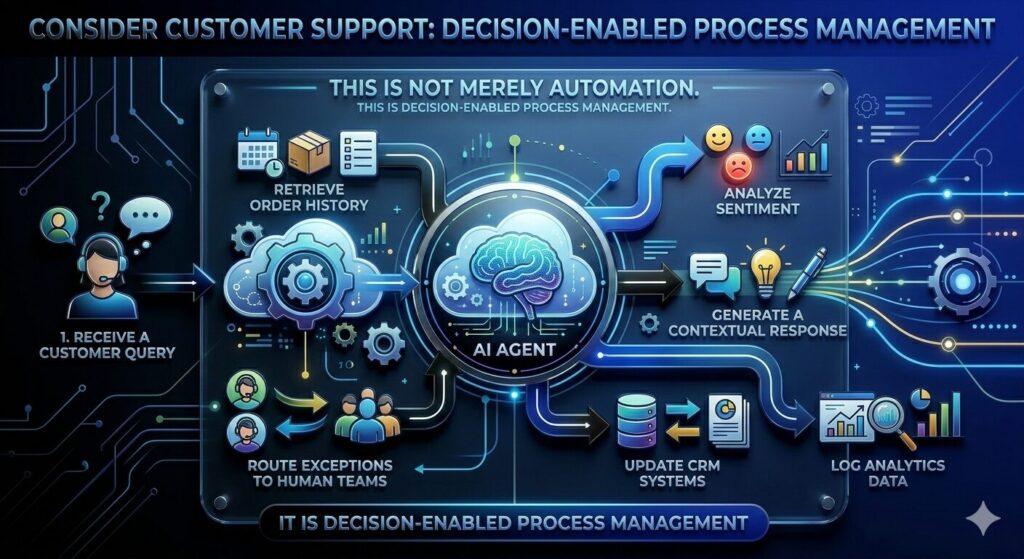
That is not automation.
That is workflow orchestration with reasoning.
IDC projects that by 2026, 80% of enterprise workplace apps will embed AI agents.
For Automation Architects, the new question is:
How do we orchestrate dozens of autonomous agents without losing control?
3.2 Hyperautomation Is Maturing Beyond RPA
If agentic AI is about intelligent decision-making within a workflow, hyperautomation is about connecting every system in your business into a single coordinated operating layer. The two concepts are complementary — agentic AI makes decisions, hyperautomation ensures those decisions propagate across every relevant system without a human having to manually carry the result from one tool to another.
Hyperautomation in 2026 includes:
- RPA
- API orchestration
- AI-driven document intelligence
- Event-driven workflows
- Process mining
- Low-code workflow builders
4. AI Compliance in 2026: The Regulatory Reality Businesses Can’t Ignore
4.1 What ‘High-Risk AI’ Actually Means for an SMB
The EU AI Act uses a risk-based classification system, and many tools that SMBs already use — or are considering — fall into regulated categories. This is not a matter of interpretation. The categories are explicit:
- AI used to screen, rank, or score job applicants = classified as high-risk
- AI-powered credit decisions or loan approval systems = classified high-risk
- AI customer profiling that influences significant commercial decisions = potentially regulated
- AI chatbots must now disclose they are not human under Article 50 — enforceable from August 2026
- Emotion recognition systems require explicit user notification before activation
If your business uses any AI-enabled hiring platform, customer scoring tool, or automated recommendation engine in a context that influences decisions with meaningful consequences — employment, credit, access to services — you are in scope.
4.2 Shadow AI: The Compliance Risk Already Inside Your Business
Shadow AI is the single most underappreciated compliance risk for SMBs in 2026. It’s the AI equivalent of employees uploading sensitive client documents to a personal Dropbox account — except the regulatory exposure is orders of magnitude higher.
- 66% of workers use AI-generated outputs without verifying accuracy
- 56% report making work mistakes they attribute to AI errors
- More than 50% of organizations lack even a basic inventory of AI tools in use
What Compliance-Ready SMBs Are Doing Differently
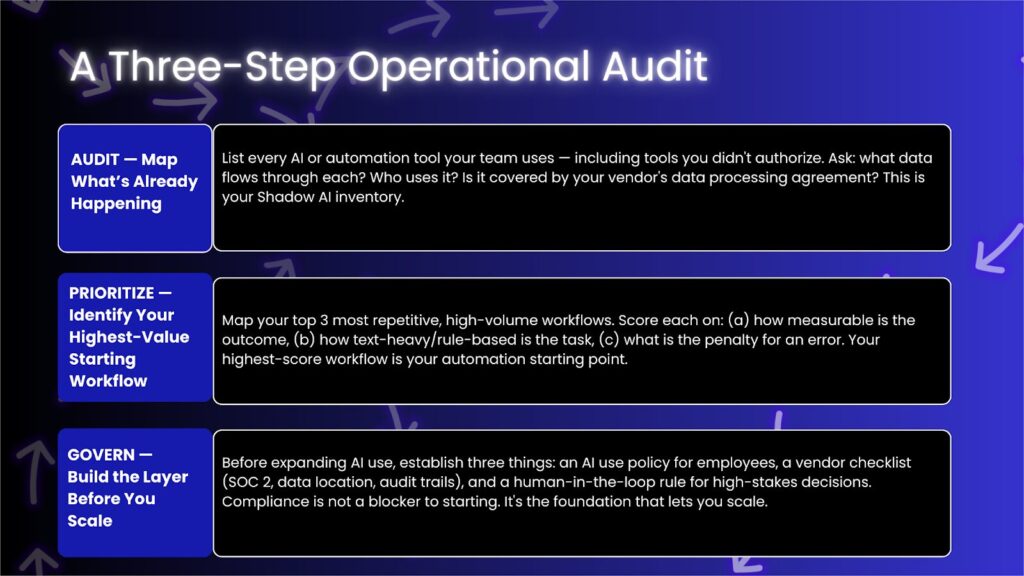
The businesses navigating this regulatory environment successfully are not doing so with large legal teams. They’re doing it with process discipline. The pattern is consistent:
- They maintain a basic AI inventory, a documented list of every AI tool in use across the business, who uses it, what data it accesses, and whether it’s covered by a data processing agreement with the vendor.
- They’ve implemented employee AI-use policies before expanding the scope of AI. The policy doesn’t need to be complex. It needs to exist and be acknowledged.
- They pressure-test vendors with four specific questions: Where does our data live? How is the model fine-tuned — does it use our inputs? What audit trails exist? Does the provider have SOC 2 certification?
- They treat cloud marketplace AI tools from AWS, Azure, and Google Cloud as preferred starting points — these platforms offer pre-vetted compliance credentials and more transparent data-handling terms than standalone AI vendors.
They’ve adopted a ‘privacy by design’ posture, building data governance into new workflows from the start, rather than treating compliance as a downstream legal check after implementation.
The Five Highest-ROI Automation Starting Points for SMBs
Based on IDC research, Valenta’s SMB implementation data, U.S. Chamber findings, and real deployment outcomes, these are the automation entry points with the most favorable combination of ROI, implementation accessibility, and measurability for small businesses:
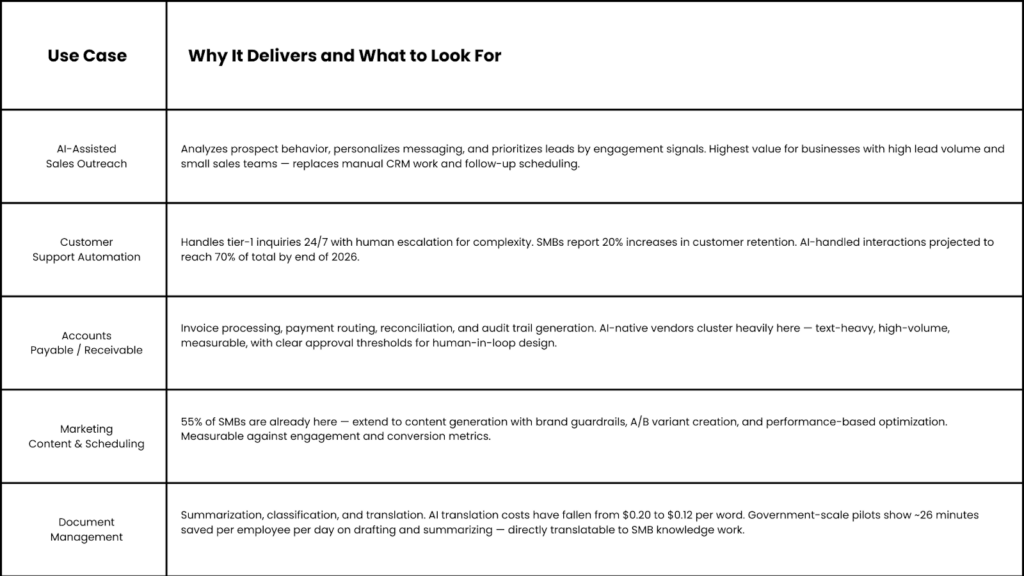
Where the Human Stays in the Loop
The biggest operational mistake in automation isn’t moving too slowly. It’s moving without a clear policy on where human judgment is non-negotiable.
- Automate fully: Repetitive, text-heavy, high-volume, low-error-penalty tasks. Scheduling, data entry, content drafts, invoice processing below approval thresholds, report generation, and meeting summaries.
- Human in the loop: Customer interactions involving complaints, escalations, or emotional complexity. Security-related decisions. Financial approvals above the defined thresholds. Any communication that is compliance-sensitive or that involves binding commitments.
- Never automate unsupervised: Cybersecurity incident responses. Legal documents. Hiring and screening decisions (now regulated). Anything that touches sensitive customer personal data without a documented governance layer and audit trail.
Start With an AI & Automation Readiness Assessment
The competitive divide of 2026 will not be defined by who uses AI.
It will be defined by translating AI potential into operational execution
The organizations that will lead in 2026 are not those experimenting with AI features. They are those engineering AI-ready operating models — integrating automation into infrastructure, decision frameworks, and governance layers simultaneously.
The next phase of automation is not about building faster processes. It is about designing intelligent operations.
Our team works with technical leaders to translate AI potential into operational execution.
Begin with an AI & Automation Readiness Assessment to understand where your organization stands and what to prioritize next.
Frequently Asked Questions
Scaling AI requires moving from isolated tools to workflow redesign. Start by identifying high-volume processes, integrating AI into decision points, ensuring clean data inputs, and establishing governance. Success comes when AI becomes part of execution—not an add-on.
RPA follows predefined rules to automate tasks. Agentic AI goes further by understanding goals, planning actions, adapting to changing inputs, and escalating when needed. While RPA executes steps, agentic AI manages outcomes across workflows.
SMBs should begin with structured, measurable workflows like support triage or invoice validation. Prioritize high-volume, low-risk processes, integrate AI into existing systems, and define success metrics early to ensure real operational impact.
Shadow AI exposes sensitive data to unmanaged tools, creating compliance, security, and IP risks. Without visibility, businesses lose control over how data is used. Governance policies and approved AI tool inventories are essential safeguards.
AI-native firms build operations around automation from the start. They automate decisions—not just tasks—reducing delays and costs. This enables faster execution, outcome-based pricing, and scalable growth without increasing headcount.
Most failures occur when AI is layered onto outdated workflows. Without redesigning processes, improving data quality, and aligning with business goals, AI becomes a tool—not a transformation driver. Real ROI comes from operational integration.
Related Blogs

February’s Tech Signals Shaping Cloud, AI, and Security Decisions

Cybersecurity 2026: Identity, AI & Security at Machine Speed