
Cloud-Native AI in Oil and Gas: Your Strategic Guide to Digital Decarbonization
Less Tech Noise. More Strategic Insights
Join 5000+ Tech leaders & CISOs receiving our deep-dive insights.


“AI is one of the most powerful tools to cut emissions today.”
– Dr. Sultan Al Jaber, ADNOC CEO, at ADIPEC 2023
The oil & gas industry is under mounting pressure to meet global energy demands while cutting emissions. Methane alone has 80× more warming power than CO₂ over 20 years, making it a top target for regulators and investors. Traditional methods, such as manual inspections and reactive maintenance, can’t keep up.
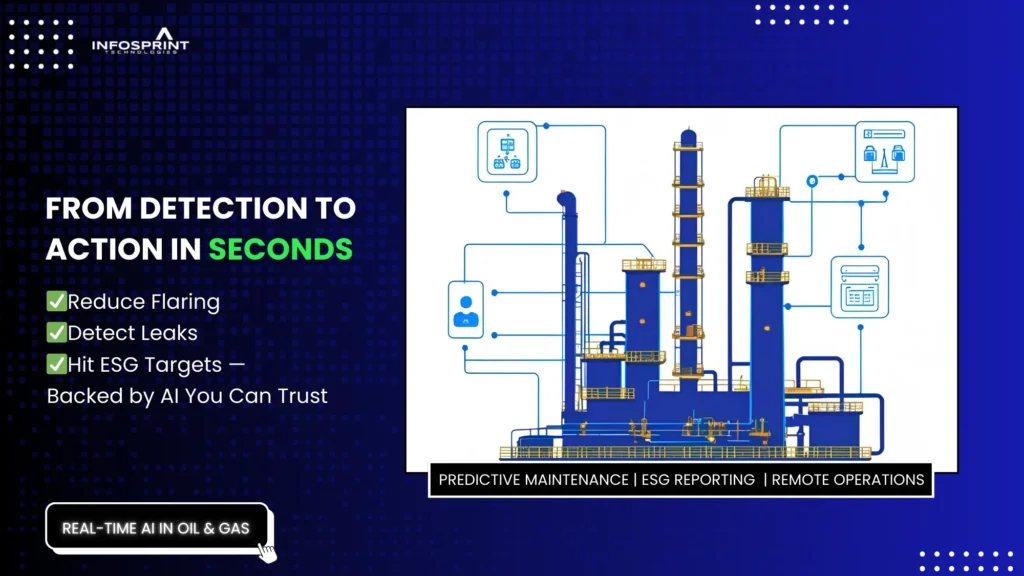
Cloud-native AI is redefining emission control with predictive analytics, smart sensors, and remote operations. From leak detection in minutes to AI-optimized flare management, leaders are seeing up to 70% methane reduction and 20% CO₂ intensity savings.
At Infosprint Technologies, a digital transformation company helping energy companies harness cloud-native AI to meet ESG goals without compromising performance. A blueprint for smart decarbonization.
Why Cloud-Native AI?
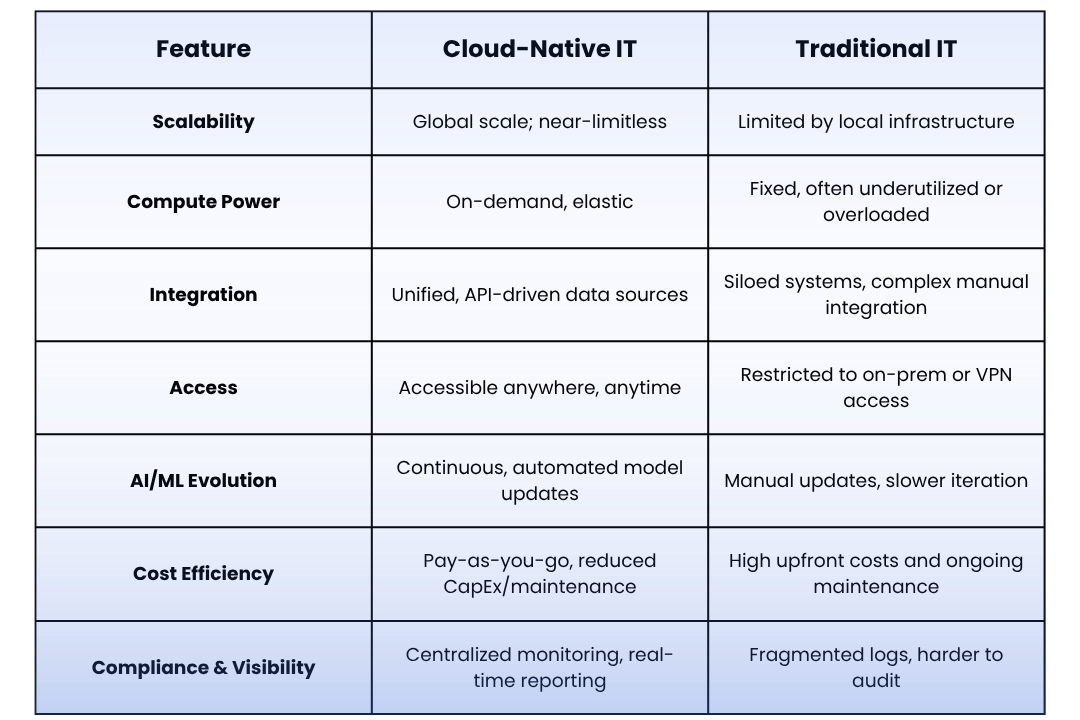
Cloud-native platforms are essential because they transform how industries handle data, operations, and sustainability. Providers like AWS, Microsoft Azure, and Google Cloud offer these capabilities. In contrast to traditional IT systems, which often face limitations due to fixed infrastructure, cloud-native architectures offer flexibility, speed, and intelligence, crucial attributes for high-emission industries such as energy, manufacturing, and logistics.
Core Capabilities of Cloud-Native AI for Emissions & Operations
Modern cloud-native AI does more than store and compute it transforms how organizations operate:
- Massive Real-Time Data Ingestion & Processing
IoT sensors, satellites, drones, and SCADA systems continuously stream structured and unstructured data to the cloud, enabling dynamic decision-making at scale - High-Resolution Detection & Analytics
ML models detect anomalies, such as gas leaks or inefficiencies, using computer vision, infrared imaging, and digital twins, thereby improving response accuracy. - Predictive & Prescriptive Maintenance
AI identifies signs of equipment wear or failure and schedules proactive repairs that reduce methane leaks and unplanned flaring. - Process Optimization for Energy Efficiency
Continuous monitoring, paired with ML-led adjustments, optimizes operating conditions, resulting in a 15–20% reduction in CO₂ emissions. - Remote Operations & Virtual Collaboration
Real-time dashboards and AI-driven alerts support safer, decentralized operations, minimizing downtime and exposure to hazardous environments. - Unified Analytics & Compliance Reporting
Centralized, real-time emissions data supports transparent reporting and automated regulatory alignment.
For a broader look at how cloud platforms enable sustainability across industries, explore our blog on 7 Ways to Embrace Sustainability with Azure & AWS Cloud in 2025.
Top Use Cases in Action with Cloud‑Native AI
Cloud-native AI is revolutionizing the oil and gas sector by delivering unparalleled capabilities for optimizing operations, enhancing safety, and promoting sustainability. By utilizing robust cloud infrastructure, AI can provide highly accurate results while unlocking new efficiencies and adding value throughout the entire energy value chain. This powerful combination is paving the way for a more intelligent and resilient future in the oil and gas industry.
A) Methane Leak Detection & Response
- Integration of satellites and IoT: Platforms like MethaneSAT utilize satellites and cloud-based AI to detect super-emitter events, facilitating prompt responses.
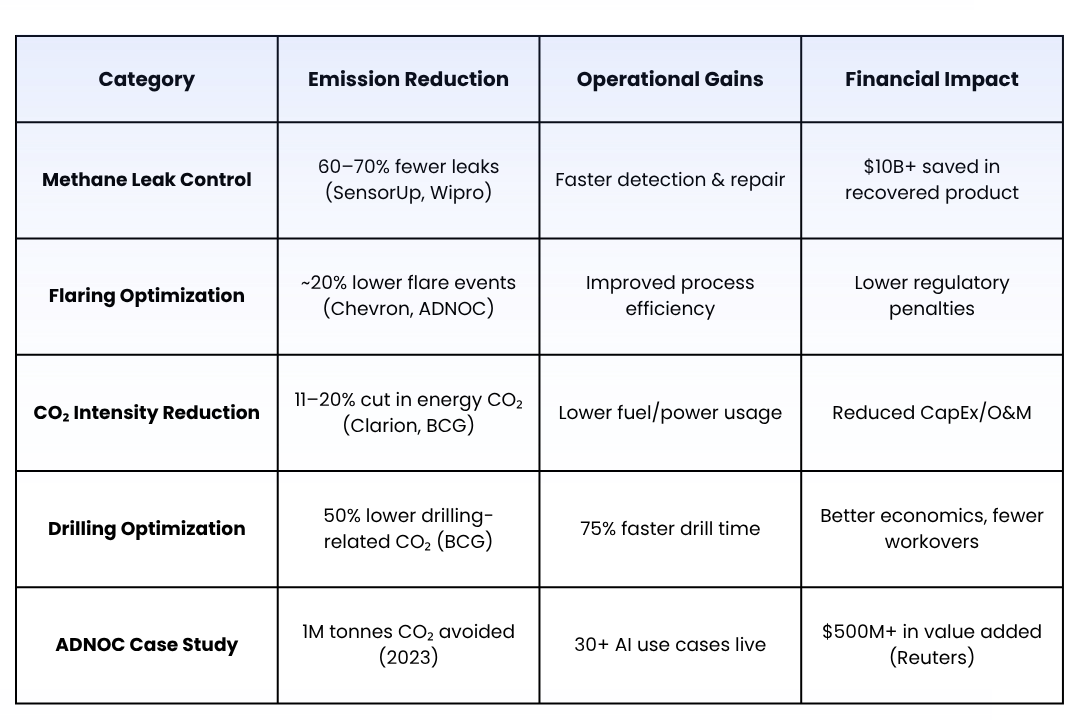
- Intelligent alerting: Wipro reports that cloud-native intelligent maintenance achieves a reduction of over 70% in methane emissions and significant financial recovery.
- Autonomous Drone Detection: In October 2025, Percepto’s autonomous drone platform received EPA approval for methane compliance monitoring, detecting emissions down to 100 grams per hour at 90% reliability
B) Flare Optimization and Flaring Reduction
- Intelligent Sensor Detection: Cloud-connected IoT sensors monitor flammable gases and activate flare control systems to minimize unnecessary flaring.
- Process Tuning with Machine Learning: AI-driven systems can adjust flare gas recovery units and compressor operations to reduce venting. Real-world pilots have demonstrated a reduction of approximately 20% in flaring.
c) Predictive & Prescriptive Maintenance
- Rod Lift Optimization: In Canada, artificial intelligence (AI) has achieved an 11% reduction in electricity usage and a 13% decrease in greenhouse gas (GHG) emissions by optimizing rod lift pumps through a cloud-based AI system.
- AI-Enhanced Plunger Lifts: These systems optimize plunger operations in real-time to prevent venting and enhance overall efficiency.
- Maintenance Alerts and Prioritization: AI models can predict equipment failures, allowing for preventive maintenance to occur before leaks develop. This proactive approach reduces both costs and emissions.
- Midstream Grease and Gas Compression: Cloud-based AI platform monitors GHG metrics and identifies anomalies to prevent high-emission incidents.
D) Operational & Process Optimization
- Energy Optimization in Refineries: Clarion’s machine learning-driven solution achieved a 20% reduction in carbon emissions at a refinery.
- Drilling and Subsurface Optimizations: A report by BCG indicates that artificial intelligence has reduced non-productive time by 50% and has similarly decreased the carbon footprint.
- Integrated Operations Centers (Agentic AI): These platforms facilitate coordination across upstream, midstream, and downstream operations. For example, in the Permian Basin, pipeline leak incidents were reduced by 30%, resulting in a $3 million savings for the company.
- Agentic AI in Operations: Leading deployments follow an observe → recommend → execute (with approval) model: the AI monitors asset health, surfaces the optimal corrective action, and awaits human sign-off before execution. This is the architecture that sits beneath self-healing pipeline networks, autonomous flare management, and compressor optimization loops. Governance and human-in-the-loop
e) Digital Twins & Remote Operations
- mCloud’s AssetCare on Google Cloud integrates satellite imagery and 3D digital twins for effective real-time leak management, allowing field workers to address leaks within hours.
- Remote collaboration enables engineers to adjust operations virtually, significantly reducing travel-related emissions.
While digital twins provide a real-time view of physical assets, combining them with Power BI dashboards offers leadership teams and field engineers a unified, intuitive interface for actionable insights. Infosprint’s data integration services help connect emissions, sensor, and operations data into interactive, drill-down reports—supporting faster decisions and more transparent ESG reporting.
Cloud-Native AI Adoption Challenges & Mitigation Strategies
While cloud-native AI offers transformative benefits for operations, sustainability, and decision-making, successful deployment requires navigating several critical challenges. Below is a detailed overview of each barrier and how forward-looking organizations can address them:
A) Data & Sensor Quality
- Challenge: AI is only as good as the data it consumes. Poor-quality sensors, inconsistent sampling, and missing or noisy data can significantly impact model accuracy and reliability, resulting in incorrect alerts or missed anomalies.
Mitigation Strategies:
- Outlier Detection Algorithms: Use statistical or ML-based anomaly detection to flag and correct data anomalies in real-time.
- Sensor Redundancy: Deploy multiple sensors at critical points to ensure backup data availability in the event of a sensor failure.
- Regular Calibration Schedules: Maintain calibration logs and routines to ensure ongoing sensor accuracy and compliance with regulations.
- Data Readiness Reality Check: only 13% of oil and gas operators have successfully scaled AI beyond the pilot stage, with 63% lacking AI-ready data practices. Sensor quality is one layer of this broader data readiness challenge. A cloud-native AI deployment is only as durable as the data pipelines, labeling practices, and governance standards beneath it
B) Legacy System Integration (SCADA, ERP)
- Challenge: Traditional operational technologies, such as SCADA and ERP, are often on-premises, customized, and not designed to communicate with cloud systems, resulting in integration friction.
Mitigation Strategies:
- Edge Gateways: Deploy edge computing gateways that act as bridges between legacy equipment and the cloud, enabling secure, real-time data transmission.
- Phased Pilots: Implement low-risk, high-ROI pilot projects (12–18 months) that incrementally integrate legacy systems, allowing learning and adjustment.
- Modern APIs & Middleware: Use integration platforms that translate data from legacy systems into cloud-compatible formats.
Tip: A hybrid architecture (cloud + edge + on-prem) is often a practical stepping stone before complete cloud migration.
C) Model Drift & Validation
- Challenge: AI models can lose accuracy as a result of shifting data patterns over time, a process called ass model drift. Without active monitoring and retraining, these models may become unreliable.
Mitigation Strategies:
- Cloud-Orchestrated Retraining Pipelines: Automate the retraining of ML models using fresh data streams via CI/CD-style ML Ops.
- Model Validation Frameworks: Implement periodic accuracy checks, validation datasets, and performance thresholds to detect degradation.
- Alerting Systems: Set thresholds that trigger alerts if model confidence levels fall below a benchmark.
Studies show that retrained models can recover up to 30% loss in accuracy caused by drift.
D) Safety & Governance
- Challenge: Autonomous AI decisions, such as shutting down a compressor or adjusting pressure, can have physical and safety implications. Such actions must be verifiable, reversible, and comply with safety standards.
Mitigation Strategies:
- Human-in-the-Loop Protocols: AI proposes actions, but humans approve or oversee final execution for critical operations.
- Fail-Safes & Rollbacks: Design AI workflows with controlled fallback modes or rollback states in case of incorrect actions.
- Audit Logging: Maintain immutable logs of every AI decision, input data, and action taken to support traceability and compliance.
E) Skills Gap & Organizational Culture
- Challenge: Many operations or engineering teams lack experience in data science, AI, or cloud computing. Cultural resistance and fear of automation also hinder adoption.
Mitigation Strategies:
- Cross-Functional Teams: Form teams combining domain experts, data scientists, and IT personnel to ensure contextual accuracy.
- Upskilling Programs: Implement AI/ML and cloud education initiatives for employees, including certifications and workshops.
- XR/VR Simulations: Use immersive training tools to simulate AI-driven scenarios in safe, virtual environments to build confidence and familiarity.
Trend: More enterprises are investing in “AI academies” to future-proof their workforce.
F) Privacy, Security & Compliance
- Challenge: Cloud-native environments must effectively manage sensitive data across jurisdictions, such as the GDPR in the EU and EPA regulations in the U.S. Failing to secure this data can result in fines, reputational damage, or data breaches.
Mitigation Strategies:
- End-to-End Encryption: To prevent unwanted access, encrypt data both in transit and at rest.
- Cloud-Native Security Tools: Leverage cloud provider tools (like AWS GuardDuty Azure Security Center) for threat detection and compliance.
- Fine-Grained Access Controls: Implement identity and role-based access (RBAC) to restrict data exposure.
- Audit Trails & Logs: Maintain traceability of data handling and processing to demonstrate regulatory adherence.
Best Practice: Align security frameworks with international standards, such as ISO/IEC 27001 and NIST.
Book a demo of our cloud-native AI platform for methane detection, predictive maintenance, and real-time ESG insights.
Step-by-Step Guide to Cloud-Native AI Implementation
Strategic implementation roadmap, a high-level, sequential guide that outlines how an organization can adopt cloud-native AI, starting from a basic readiness assessment to full-scale, enterprise-wide integration.

Step 1: Baseline assessment
Begin with a clear understanding of your organization’s current emissions profile and asset performance baseline.
- Map existing emissions sources (Scope 1 direct emissions and Scope 2 indirect emissions from purchased energy).
- Identify relevant IoT, SCADA, ERP, and sensor data sources and assess data quality.
- Benchmark current asset reliability metrics: uptime, MTTR, unplanned downtime frequency.
- Assess infrastructure readiness for cloud integration.
Step 2: Pilot a Simple Use Case
Start with a focused, manageable AI project, such as methane leak detection on high-risk valves using infrared sensors and cloud-based ML.
- Choose a single problem with clear measurable outcomes (leak reduction, downtime avoidance, or emission savings)
- Deploy cloud-native architecture (e.g., AWS IoT, Azure AI)
- Involve the OT and IT teams collaboratively from day one to prevent downstream integration failures.
Step 3: Demonstrate Results
Translate pilot outcomes into clear business and sustainability metrics.
- Measure leak reduction, downtime avoidance, or emission savings
- Document regulatory/reporting improvement.
- Share outcomes internally to build support
Step 4: Scale & Integrate
Extend successful pilots across various asset classes (e.g., turbines, compressors, and storage facilities) and integrate AI with existing systems, such as SCADA and ERP.
- Use APIs or edge gateways to connect legacy systems
- Expand models to cover additional emission points
- Deploy a centralized cloud dashboard
Step 5: Evolve AI maturity from Predictive to Agentic
Progress from detection models through prescriptive AI to agentic AI that recommends or, with human approval, executes operational decisions autonomously.
- Enable AI to prescribe actions (e.g., throttle adjustments, maintenance scheduling, compressor setpoint changes).
- Introduce agentic AI under strict human oversight: deploy the observe → recommend → execute (with approval) model before moving toward any autonomous execution loop. Agentic AI in energy is growing at 36.65% CAGR — your operations and IT teams need governance frameworks in place before the technology outpaces them.
- Apply reinforcement learning or digital twin simulation to test autonomous decision logic in safe environments before live deployment.
Step 6: Continuous Optimization
Set up ongoing monitoring and retraining of AI models as operations evolve and new data is ingested.
- Use CI/CD pipelines for AI (MLOps)
- Schedule model validation and retraining
- Integrate AI alerts into daily workflows
Step 7: Governance Framework
Establish robust policies around data privacy, decision authority, AI ethics, and operational fail-safes. This is especially critical as deployments mature toward agentic automation.
- Define boundaries for autonomous AI.
- Implement audit trails and human-in-the-loop systems
- Align governance with standards like ISO, NIST, GDPR, and EPA
Discover our Energy Industry Digital Transformation Solutions and learn how we assist companies in modernizing their emissions management.
Lead the Change with Infosprint: Unlock a Greener Future with Cloud-Native AI in Oil & Gas
Every ton of CO₂ saved is no longer just good PR; it’s a competitive differentiator.
Cloud-native AI is no longer a futuristic vision; it’s a present-day advantage for oil & gas operators navigating rising emissions pressure, cost volatility, and ESG scrutiny.
With the proper implementation, organizations unlock a synergistic path to transformation:
- Cut emissions: Methane leaks, CO₂ intensity, flaring, and unscheduled reworks are significantly reduced.
- Boost efficiency: Real-time optimization and analytics result in lower operational costs (~15–20% savings).
- Improve asset reliability: AI-driven maintenance reduces unplanned downtime and MTTR across critical equipment, directly improving throughput and cost-per-barrel performance.
- Enhance safety: Automated alerts and remote monitoring increase operator safety.
- Gain regulatory advantage: Meeting stringent standards and enabling transparent reporting.
- Boost investor confidence: ESG-friendly innovations strengthen market positioning.
The industry is shifting. Will you lead the change or be disrupted by it?
Let Infosprint Technologies help you build a smarter, safer, and greener energy future.
Frequently Asked Questions
Predictive AI tells you what is likely to happen. Agentic AI assesses the situation, drafts a work order, routes it for approval, and can autonomously execute corrective actions in controlled environments. Most operators are adopting an observe → recommend → execute (with approval) model, requiring human sign-off for significant actions.
To succeed, prioritize data readiness as a mandatory requirement. Create a unified, vendor-agnostic data layer first, run pilots on clean, accessible data, and define financial KPIs (like NPT reduction and MTTR improvement) within 30 days to ensure the pilot delivers a compelling ROI narrative.
In 2025, AI’s ROI in oil and gas improved significantly, with BCG predicting a 30–70% EBIT uplift for full adopters over five years. ADNOC generated $500 million in value from AI tools and avoided 1 million tons of CO₂. Predictive maintenance often pays back in 12 months, while a Permian Basin case study saved $3 million by reducing leaks by 30%. ROI calculations should connect KPIs to financial outcomes, like linking NPT reductions to recovered production.
The EPA’s Waste Emissions Charge was rolled back by Congress in March 2025, suspending its payment mechanism. However, the underlying obligation in the IRA remains, requiring a separate legislative act for repeal, which is still in progress as of mid-2026. This means compliance strategies are paused, not reversed. Operators who leverage this time to reduce methane intensity using cloud-native AI will be better positioned for future enforcement and will meet the EU Methane Regulation, Canada’s carbon pricing, and investor ESG disclosure needs, independent of US federal policy.
To implement a cloud AI program, use a phased hybrid architecture. Start with edge gateways that connect legacy SCADA systems to the cloud for real-time data transfer. Deploy edge computing, stream data securely, run AI models, and provide alerts via dashboards, avoiding direct SCADA integration initially. Follow IEC 62443 cybersecurity standards and pilot for 12–18 months in low-risk areas before expanding.
Related Posts
Top 10 Cloud Computing Technologies to Look Out for in 2025
Consistent Diagnosis: The Cornerstone of Modern Healthcare