
April 2026 Tech Brief That Will Shape Q2 and Q3 Decisions


- The AI Model Arms Race: 19 Models in 17 Days
- Anthropic Builds Its Most Powerful AI
- OpenAI Moves Into Advertising
- Google Cloud Next ’26
- AI Cloud Spend Governance Crisis: When the Bill Arrives
- The Mercor Breach: When AI Training Data Becomes the Target
- April Patch Tuesday: 67 Flaws, 2 Zero-Days Under Active Exploitation
- One Month of Signals. One Conversation to Make Sense of Them
- FAQs
AI is becoming more capable, more expensive, and less forgiving of governance gaps
Because none of these developments happens in isolation. A model release changes how fast your teams can ship. A cloud announcement reshapes your architecture decisions. A supply chain breach exposes risks buried deep within your AI stack. When you connect them, the signal becomes clear: the technology landscape isn’t just evolving, it’s compressing, and the margin for delayed decisions is disappearing.
At Infosprint Technologies, we break down what’s happening across AI, cloud, cybersecurity, and automation into what leaders actually need. Because the advantage no longer goes to the most informed, it goes to those who can turn signals into action faster.
1. The AI Model Arms Race: 19 Models in 17 Days
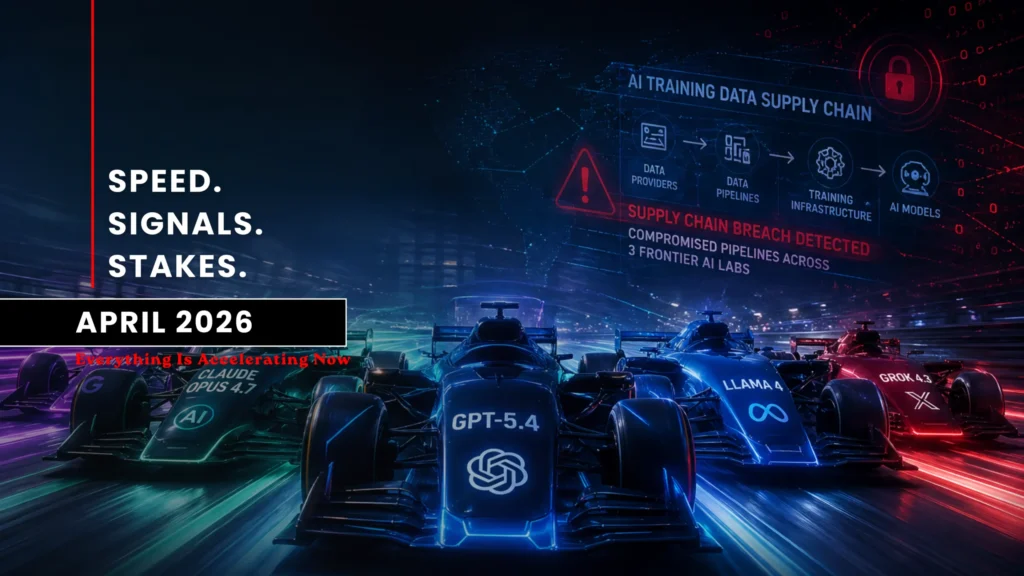
April witnessed the history’s biggest AI model race. Between April 1 and April 17, 19 major AI model updates shipped across every major AI lab.Claude Opus 4.7 (Anthropic, April 16), Grok 4.3 Beta (xAI, April 17), Llama 4 Scout and Maverick (Meta, April 5), Gemma 4 (Google, April 2), etc., all within the same two-week window.
The AI model velocity we tracked in March, when 12+ major releases hit in a single cycle, has now accelerated further.
What this reveals
The performance between frontier models has been fine-tuned to a level where it is not about using an AI model but selecting the one with the functions that match specific workflows you are optimizing for.
Key takeaways:
- Build a model evaluation framework now — not when the next release forces your hand. Define the specific tasks, accuracy thresholds, and latency requirements that matter to your organization.
- Separate benchmark performance from production readiness. A model scoring highest on SWE-bench may not be the right fit for your regulatory environment or data classification requirements.
- The real strategic advantage in 2026 is not which model you use — it is how quickly your organization can evaluate, integrate, and redeploy as the landscape shifts.
2. Anthropic Builds Its Most Powerful AI
Mythos the most powerful AI model built to date. Internally code named capybara, it scored 93.9% on SWE-bench Verified and 94.6% on GPQA Diamond during internal testing, placing it meaningfully above every publicly available model in April 2026.
However, the most powerful AI model has yet to see the light of day. Anthropic’s decision to withhold this model is not without justification. The model independently identifies thousands of zero-day vulnerabilities across major operating systems and browsers during testing, triggering Anthropic’s ASL-4 safety protocol.
In a limited deployment. Anthropic provided limited access to Microsoft, Apple, AWS, and JPMorgan. But this raised questions about whether it reduces systemic risk or just consolidates defensive advantages.
What this reveals:
Having this powerful tool commercialized could allow cybercriminals to use it to breach your security.
Key takeaways:
- Evaluate whether your security program is calibrated for AI-assisted threat discovery. The volume of vulnerabilities that could surface from this class of model exceeds manual triage capacity.
- Organizations buying AI services should now ask vendors for their AI Safety Level classifications and deployment restrictions.
- Boards and audit committees should be briefed on what ASL-4 means in operational terms. It has direct implications for enterprise risk exposure.
3. OpenAI Moves Into Advertising
OpenAI plans to go toe-to-toe with the AD giants Meta and Google. OpenAI plans to shift its budgeting from impression-based to cost-per-click. It is also exploring action-based ad formats designed to drive specific outcomes(app downloads, purchases, service signups).
OpenAI projects $2.5 billion in ad revenue for 2026. Its ad pilot, launched in February, already topped $100 million in annualized revenue in under two months with more than 600 advertisers. The ad pilot has been extended beyond its original March deadline, signaling that advertising is now a permanent infrastructure rather than a limited experiment.
What this reveals
OpenAI lost an estimated $57 billion in 2026 against its revenue base. Advertising is not a growth experiment; it is a financial necessity at scale.
Key takeaways
- Review your organization’s ChatGPT tier. If teams use the free or Go tiers, they will see ads. Assess whether this is acceptable for the sensitivity of the workflows those teams are running.
- Update vendor assessment frameworks to include advertising architecture as a due diligence criterion when evaluating AI providers for enterprise use cases.
- Procurement teams should negotiate contractual clarity on data isolation between advertising infrastructure and enterprise workspaces before the ad ecosystem matures further.
4. Google Cloud Next ’26
At the Google Cloud Next event, the CEO announced that Google aims to be a full-stack operating environment for Agentic enterprises, not just an AI infrastructure provider.
The headline launches the Gemini Enterprise platform, an end-to-end workspace to build, govern, and scale AI agents, incorporating Gemini 3.1 Pro, a new Agent Designer, an Agent Inbox for managing agent activity, long-running agent support, and a centralized Skills registry.
Google Cloud is also making its largest-ever partner investment, a $750 million innovation fund to accelerate agent deployment across its partner and integrator ecosystem
What this reveals:
Google’s integrated stack plays proprietary chips, frontier models, agentic data infrastructure, and security tooling is a direct response to the fragmentation problem enterprises report when assembling AI capability from multiple vendors.
Key takeaways:
- If your organization is currently in a multi-year Google Workspace or Google Cloud agreement, evaluate whether the Gemini Enterprise Agent Platform materially changes the value of that commitment.
- The Agentic Defense launch warrants a direct conversation with your security team. AI-simulated red, blue, and green team capabilities are now available as a managed cloud service. This changes the build-vs-buy calculus for security operations.
- Assess whether your data architecture is compatible with Apache Iceberg. The Cross-Cloud Lakehouse announcement positions Iceberg as a strategic standard — organizations that have not yet adopted it may face friction when integrating future AI workloads.
5. AI Cloud Spend Governance Crisis: When the Bill Arrives
In April, global cloud spend reached $110 billion in Q4 2025. The problem is not AI, but a significant portion of that spend is not connected to measurable outcomes.
Cost overruns from unmanaged AI workloads are the primary concern for FinOps. GPU costs are rising, and cloud providers face pressure from rising energy prices and model training investment. And approximately 98% plan to use a multi-vendor approach to prevent lockout.
Why this reveals
Cloud pricing will not decrease the way it did in 2025. Amazon’s GPU price cuts of up to 45% last June were an exception, not a trend. Leaders planning budgets under the assumption of continued cost deflation are building on a flawed foundation.
The hybrid cloud cost pressure we tracked in February has now been compounded by agentic AI workloads that behave nothing like the static compute models FinOps tooling was built for.
Key takeaways:
- Establish AI workload cost attribution before scaling. The inability to map cloud spend to specific outcomes is the single most common failure mode in enterprise AI investment reviews.
- Evaluate your current commitment structures against projected AI workload growth. Multi-year reserved instance agreements signed before agentic AI became standard may not reflect your actual usage profile.
- Build FinOps capability into AI deployment workflows, not as a retrospective audit function. Real-time cost monitoring for AI workloads should be a deployment requirement, not an afterthought.
This isn’t just an analyst concern. At our April SMB Cloud Event in Hyderabad, attended by 50+ business leaders and IT decision-makers cloud bill unpredictability ranked as the top operational challenge, outpacing security and performance concerns
6. The Mercor Breach: When AI Training Data Becomes the Target
Mercor, a $10 billion AI hiring startup that recruits domain experts to help train models for OpenAI, Anthropic, and Meta, confirmed it was breached via a compromised version of LiteLLM.
The scale of the breach: 4 terabytes of data exfiltrated, including the personal data of over 40,000 contractors (Social Security numbers, passport scans, biometric data), proprietary source code, video interviews, and most significantly, AI training methodologies belonging to multiple frontier labs.
What this reveals:
Knowledge of how frontier AI labs collect and structure training data could allow adversaries to more effectively poison that data at source. Access to model architecture details could enable targeted prompt injection or the development of adversarial models. The breach is not just a data privacy incident it is a potential threat to the integrity of the AI models that downstream organizations are deploying.
Key takeaways:
- Pin dependency versions with cryptographic hashes in all production AI environments. Organizations that use lockfiles such as poetry.lock or uv.lock were completely protected from the malicious LiteLLM packages. Those relying on mutable version tags inherited the full attack chain.
- Require supply-chain security controls from AI data and tooling vendors as a contractual condition, not an audit checkbox. The Mercor incident illustrates that the vendor layer connecting you to AI training workflows is now a primary attack surface.
- Audit your compliance certification providers. The Delve Technologies scandal has exposed a gap in the GRC certification market — certificates that claim to validate security posture but were generated without substantive assessment.
7. April Patch Tuesday: 67 Flaws, 2 Zero-Days Under Active Exploitation
Microsoft’s April Patch Tuesday addressed 67 vulnerabilities, including two zero-day flaws that were confirmed as actively exploited in the wild at the time of the patch release. One of the most significant is CVE-2026-32202, a spoofing vulnerability in Windows Shell (CVSS 4.3) that Microsoft initially disclosed and then revised its advisory to acknowledge active exploitation. Sensitive data can be accessed by an attacker thanks to the vulnerability. by sending a victim a malicious file to execute — a delivery mechanism that requires only a successful phishing attempt.
What this reveals:
The attack surface is expanding faster than patch cadences can contain it. Two simultaneous zero-days under active exploitation in a single Patch Tuesday, combined with over a billion unpatched Android endpoints, illustrates that the exposure window for known vulnerabilities now exceeds the realistic response capacity of most enterprise security teams.
This is not a new pattern — patch velocity first emerged as a board-level variable in January, when a Microsoft emergency patch exposed how quickly vulnerabilities can be exploited and cause damage.
Key takeaways
- Review your patch deployment SLA for Windows environments. If your standard testing and deployment cycle exceeds seven days, you are incurring quantifiable exposure for every zero-day disclosed on Patch Tuesday.
- Reassess your mobile device management policy for Android devices. Establish a minimum OS version requirement for any device accessing corporate resources — and enforce it technically, not just through policy.
- Brief your board on patch velocity as a risk variable. The lag between disclosure and deployment is now a metric that belongs in risk reporting alongside dwell time and mean time to detect.
One Month of Signals. One Conversation to Make Sense of Them
When viewed together, April’s developments reveal a single underlying dynamic:
Before Q2 plans finalize into long-term commitments, technology leaders should be asking:
- Do we have a model evaluation framework that can process a new frontier release in days, not weeks?
- Have we reviewed our AI vendor contracts for data isolation, advertising architecture, and safety classification terms?
- Which elements of our AI toolchain rely on open-source dependencies that have not been pinned and cryptographically verified?
- Where are we deploying AI agents without defined governance boundaries, override paths, or cost controls?
- Has our mobile device management policy been updated to reflect the one billion Android endpoints now permanently outside the security patch ecosystem?
- Are our cloud cost structures calibrated for agentic AI workloads — or were they designed for the per-request model that no longer reflects actual usage?
A focused conversation can help you separate the signals that need action this quarter from the ones you can monitor into Q3. Talk to the Infosprint team
Frequently Asked Questions
April 2026 saw 19 major AI model releases in 17 days, the unprecedented withholding of Anthropic’s Claude Mythos on safety grounds after it identified thousands of zero-day vulnerabilities, and OpenAI’s formal move into cost-per-click advertising. Together, they represent the convergence of capability acceleration, safety governance maturity, and commercial model transformation.
Google launched the Gemini Enterprise Agent Platform, its eighth-generation TPU chips (80% better inference performance per dollar), the Agentic Data Cloud with Cross-Cloud Lakehouse support, Agentic Defense integrating Wiz’s security platform, and a $750 million partner innovation fund. Sundar Pichai also disclosed that 75% of all new code at Google is now AI-generated.
The Mercor breach exposed 4 terabytes of data — including AI training methodologies from OpenAI, Anthropic, and Meta — through a compromised LiteLLM package available for 40 minutes on PyPI. The attack chain began with a compromised security scanner (Trivy), moved to LiteLLM’s CI/CD pipeline, and cascaded to thousands of downstream environments. The compliance certifications attached to LiteLLM were subsequently exposed as fraudulent. Immediate actions: pin dependencies, rotate credentials, and audit your GRC certification providers.
Starting June 1, 2026, GitHub Copilot moves from request-based to token-based billing using AI Credits. Base plan prices remain unchanged, but model multipliers increase substantially — Opus 4.7 moves from 7.5x to 27x. Agentic workflows will generate significantly higher costs than equivalent request volumes under the old model. Engineering leaders should use GitHub’s May preview billing tool to model the impact before the transition date.
Build a model evaluation framework tied to specific organizational use cases — not general benchmarks. Define the accuracy thresholds, latency requirements, cost ceilings, and regulatory constraints that apply to your highest-priority workflows. When a new model releases, you should be able to assess its fit in days. Organizations without this framework will consistently be making adoption decisions under time pressure, which is when mistakes are made.
Related Blogs
Low-Code Security Risks: 6 Governance Gaps That Will Fail Your Next Audit

Cloud Data Analytics for Manufacturing: Faster Decisions, Less Downtime