
Less Tech Noise. More Strategic Insights
Join 5000+ Tech leaders & CISOs receiving our deep-dive insights.
AI Health Kiosks: A Security and Compliance Perspective


- Why Healthcare Systems Are Adopting AI Health Kiosks
- Where AI Health Kiosks Are Used Today — From Convenience to Clinical Decisions
- Patient Safety and Compliance Risks in AI-Driven Touchpoints
- The Hidden Risk: How it Collect and Process Regulated Health Data
- Edge Devices and Regulated Data: The Security Risk
- Governing AI-Driven Patient Interaction
- Can Your Cloud and Security Stack Support This Model?
- Ownership and Accountability: Security, Uptime, and Compliance
- Risk-Based Deployment: What Successful Implementations Get Right
- Enabling Secure, Compliant AI Health Infrastructure
- FAQs
Shorter Queues | Faster Check-ins | Automated Vitals
-AI health kiosks as a convenience play
But the moment a kiosk touches patient data, it becomes part of our risk surface.
AI health kiosks are not primarily a healthcare problem. They are a security, data governance, and regulatory compliance problem operating at the very edge of care.
Once deployed, they collect protected health information (PHI), influence patient routing, and integrate with cloud platforms and EHR systems—often outside traditional clinical controls. At that point, the real questions change –
- Can regulated data be secured beyond core systems?
- Can AI-driven patient interactions be governed and audited?
- Who owns accountability when automation fails —
- Is your cloud and security architecture ready for it?
This is where security, compliance, and architecture cease to be support functions and become the foundation.
Why Healthcare Systems Are Adopting AI Health Kiosks
Across the healthcare industry, ctaff shortages, overcrowded emergency rooms, aging population, and the after effects of large-scale infectious disease outbreaks have accelerated the adoption of AI health kiosks.
Research—including a comprehensive U.S.-based review published in Nature—shows that health kiosks are increasingly used to:
- Measure and record vital signs
- Support screening and diagnosis of chronic conditions such as hypertension and diabetes
- Enable remote or self-service care pathways
- Reduce strain on frontline healthcare staff
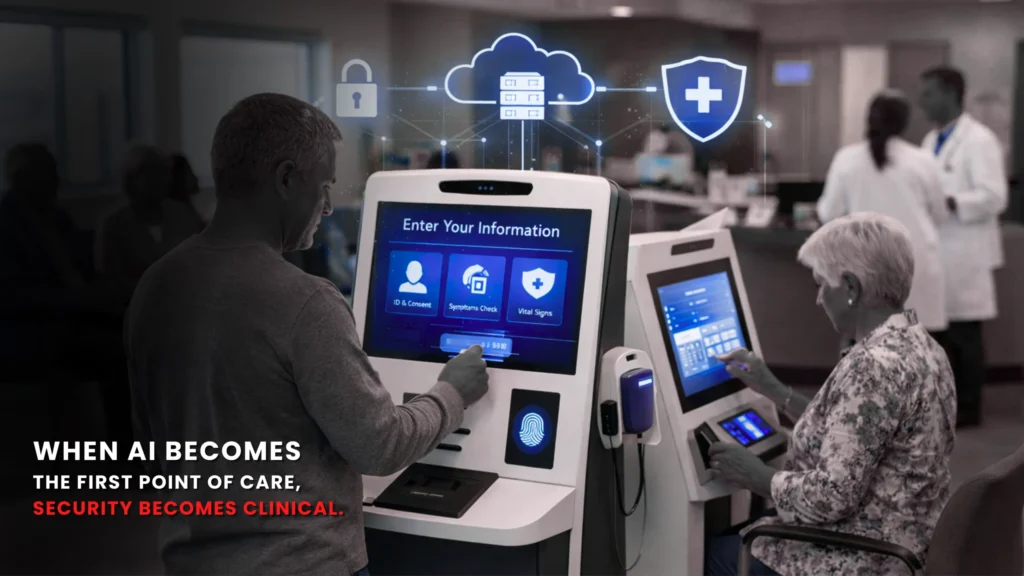
As adoption scales, AI health kiosks are no longer standalone tools. They are embedded into clinical workflows, integrated with electronic health record (EHR) systems, and connected to cloud platforms. In many healthcare environments, they now function as the first point of patient interaction, placing them squarely within the regulated healthcare delivery chain.
Where AI Health Kiosks Are Used Today — From Convenience to Clinical Decisions
Already part of a wider digital transformation in healthcare, AI-powered health kiosks are way out of experimental labs. The common environments include:
- Public and private hospitals
- Polyclinics and outpatient centers
- Pharmacies and community health hubs
- Government-sponsored healthcare facilities
- Remote and underserved care locations
Modern healthcare kiosks do much more than gather basic vitals. Depending on the configuration, they may:
- Capture patient identity and consent
- Physiological parameters will be measured: blood pressure, weight, glucose, and temperature.
- Collect symptom inputs via guided interfaces
- Analyze recent laboratory results
- Classify patients into risk or control categories
- Route patients to nurses, physicians, or self-care pathways
For Instance:
Singapore’s public healthcare system has sent a notable signal. A feasibility study conducted at a SingHealth Polyclinics location demonstrated how an AI-enabled kiosk could replace traditional doctor visits for stable chronic disease follow-ups.
Over a nine-month period, patients used the kiosk for two consecutive follow-up visits instead of seeing a physician. The system combined physiological readings with recent lab results to classify disease control levels and issue clear next-step instructions—either to continue the current treatment or escalate to clinical staff.
From an operational perspective, the study reported high levels of acceptance and satisfaction among both patients and healthcare providers. AI kiosks are already making clinical classifications and influencing care pathways.
Patient Safety and Compliance Risks in AI-Driven Touchpoints
When AI kiosks are implemented in a clinical setting, they come into the patient decision-making stream. This leads to an intersection of risks as follows:
- Clinical risk – incorrect stratification, redistribution, or delayed upgrade
- Operational risk – downtime, misconfiguration, or device failure
- Regulatory risk – mishandling of PHI, consent issues and audit gaps
- Trust risk – Loss of patient trust as a result of errors attributed to automation
Even where the kiosk is not making final diagnoses, it is first acting as a gatekeeper. This is because it is determining whether the patient goes on his own, to the nurse, or to the physician. In health regulation frameworks, this classifies it as part of the healthcare chain.
This distinction matters because many organizations still treat kiosks as peripheral tools rather than regulated digital assets. That gap between perception and reality is where compliance failures typically emerge.
The Hidden Risk: How it Collect and Process Regulated Health Data
Among the most conspicuously underemphasized elements of health kiosks using artificial intelligence is where the data processing and storage actually occur.
A typical kiosk interaction may collect the following data:
- Patient identification information
- Physiological measurements
- Laboratory current data
- Interaction logs and timestamps
- Automatic classifications or recommendations made by AI
This data is not always limited to traditional hospital settings. Rather, it can move between on-device processing elements to edge computing layers, cloud-based AI services and integration APIs connected to EHR platforms.
Collecting regulated health data in ways that are not part of core system processes raises several issues related to:
- Data residency and sovereignty
- Encryption and key management
- Third-party access and subcontractors
- Inconsistent logging and audit trails
The Real Question is: Whether the entire data cycle is governed, visible, and auditable?
Edge Devices and Regulated Data: The Security Risk
The impact of unsecured digital touchpoints is already evident in real-world healthcare data breaches, in which exposed systems have led to regulatory penalties and loss of patient trust.
1) Physical and Environmental Risks
Kiosks are often deployed in semi-public environments. Risks include:
- Device tampering
- Unauthorized physical access
- Hardware replacement or skimming
- Environmental damage impacting integrity
2) Application and OS-Level Risks
Many kiosks run customized operating systems and applications. Without strict hardening:
- Unpatched vulnerabilities persist
- Local privilege escalation becomes possible
- Malware injection risks increase
3) Network and API Risks
Digital Kiosks depend on constant connectivity:
- Insecure APIs expose patient data
- Man-in-the-middle attacks compromise transmissions
- Poor segmentation allows lateral movement
4) AI and Model-Level Risks
AI components introduce non-traditional risks:
- Model manipulation or inference abuse
- Unclear explainability of outputs
- Lack of traceability for AI-driven decisions
5) Third-Party and Supply Chain Risks
Most kiosk deployments rely on:
- Hardware vendors
- AI model providers
- Cloud service platforms
- Integration partners
Each adds dependency and accountability complexity.
Governing AI-Driven Patient Interaction
Simply relying on security controls is insufficient. AI health kiosk systems require clear guidance on their logic structure to interact with patients.
Key questions for the governance framework:
- Who approves the AI decision pathways?
- How are thresholds and classes established and changed?
- When does AI call for human involvement?
- What happens to incorrect or ambiguous results?
- Is the AI explanation interpretable and auditable?
However, the implementation success in kiosks was not restricted to the technology. It involved workflow, language support, and well-defined rules for escalation. In the absence of such boundaries, patient autonomy can quickly devolve into patient danger.
In a compliance capacity, governance should ensure that:
- Outputs generated by the AI can be traced and recorded
- Human oversight is available where required
- Patients are informed and consent appropriately
- Regulatory expectations are met consistently
In AI-driven environments, maintaining consistency in digital diagnosis is as much a governance challenge as it is a clinical one.
Ownership and Accountability: Security, Uptime, and Compliance
One of the most common failure points in kiosk deployments is unclear ownership.
AI health kiosks sit at the intersection of:
- IT infrastructure
- Security operations
- Compliance and risk management
- Clinical operations
- Vendor-managed services
Without explicit accountability:
- Security incidents escalate slowly
- Compliance gaps go unnoticed
- Downtime impacts patient flow
- Vendors and internal teams shift responsibility
Effective deployments define ownership across the entire lifecycle:
- Procurement and vendor assessment
- Secure configuration and deployment
- Ongoing monitoring and patching
- Incident response and reporting
- Secure decommissioning
This clarity is essential not only for operations but also for audits and regulatory reviews.
Can Your Cloud and Security Stack Support This Model?
AI health kiosks place new demands on companies’ architecture. Organizations must evaluate whether their existing cloud and security stack can support:
- Strong identity and access management
- Role-based access for staff and systems
- Device identity and authentication
- Role-based access for staff and systems
- End-to-end encryption
- Data at rest and in transit
- Secure key management
- Data at rest and in transit
- Continuous monitoring and logging
- Centralized visibility across devices and cloud services
- Audit-ready logs
- Centralized visibility across devices and cloud services
- Secure integration
- APIs connecting kiosks to EHR and core systems
- Controlled data exchange boundaries
- APIs connecting kiosks to EHR and core systems
- Scalability without risk amplification
- Adding devices without adding blind spots
If these foundations are weak, the AI healthcare kiosk deployments amplify risk rather than efficiency. Supporting AI health kiosks at scale requires strong identity controls, encryption, continuous monitoring, and audit readiness—core elements of healthcare cybersecurity and compliance.
Risk-Based Deployment: What Successful Implementations Get Right
Successful kiosk deployments follow a risk-based rollout strategy rather than a purely operational one.
Key practices include:
- Starting with low-risk environments
- Defining clear success and failure criteria
- Conducting security and compliance reviews before scaling
- Testing incident response procedures early
- Reassessing risk as functionality expands
The Singapore case study illustrates this principle well. The kiosk deployment focused on stable chronic disease patients, clearly defined escalation paths, and a limited scope before broader adoption. This approach allowed innovation without compromising safety or compliance.
Enabling Secure, Compliant AI Health Infrastructure
Infosprint’s expertise lies in the enterprise layers that determine whether AI health kiosk deployments remain secure, compliant, and operational at scale. This includes designing and securing cloud architectures, enforcing identity and access controls, governing data flows, and integrating kiosks safely with core healthcare systems.
Organizations that see AI health kiosks as regulated assets can scale confidently. Infosprint helps manage risk throughout its lifecycle.
In other words, AI health kiosks succeed or fail long before a patient ever touches the screen. Its effective deployments needs:
- Secure cloud backends capable of handling regulated data
- Identity and access management across devices, users, and systems
- Data encryption and compliance controls aligned with healthcare regulations
- AI governance and monitoring to ensure safe, explainable interactions
- Integration with EHR and core healthcare systems
- Managed operations to maintain security, uptime, and audit readiness
This is not about devices — it is about building and operating the secure digital infrastructure that allows AI-driven healthcare innovation to scale responsibly.
If AI healthcare touchpoints are part of your roadmap 2026, discuss your healthcare security readiness with our cybersecurity experts.
Frequently Asked Questions
AI health kiosks pose several security risks due to their operation at the intersection of edge devices, cloud platforms, and regulated healthcare data. Key risks include unauthorized physical access, insecure APIs, data leakage, weak device authentication, and inadequate monitoring of AI interactions. As these kiosks are outside core hospital systems, security gaps can directly expose protected health information (PHI).
AI healthcare kiosks must adhere to the same regulatory frameworks as digital health systems. In the U.S., this includes HIPAA for the protection of PHI. Canada and the EU follow GDPR for consent and data handling, while Singapore’s PDPA governs personal data. India is updating its digital health regulations. Compliance depends on how data is collected, processed, stored, and integrated.
Effective data governance for AI health kiosks involves clear data ownership, defined access controls, and visibility of data flows. Key practices include encrypting data, maintaining audit logs, limiting AI decision scope, enforcing human oversight, and ensuring third-party compliance with healthcare standards. Governance should cover the entire kiosk lifecycle, from deployment to decommissioning.
Securing AI-driven healthcare kiosks requires a layered security approach. This includes device hardening, strong identity and access management, secure API integrations, continuous monitoring, and regular risk assessments. Breach prevention also depends on governance—defining who is responsible for security, how incidents are handled, and how compliance is validated during audits.
Secure integration between AI health kiosks and electronic health record (EHR) systems relies on controlled APIs, strict authentication, encryption, and role-based access. Data exchanged between kiosks and EHR platforms must be logged, traceable, and compliant with healthcare regulations. Poorly governed integrations are a common source of compliance gaps and security incidents.
Yes, AI health kiosks can be compliant with HIPAA, PDPA, and GDPR—but only when they are designed with compliance in mind. This includes proper consent handling, data minimization, encryption, audit logging, and governance over AI decision-making. Compliance is not achieved solely by the kiosk; it depends on the supporting cloud, security, and operational architecture.
Related Blogs
Top Cloud Technology Trends for 2026: The Agentic Cloud Shift

Beyond ISO 27001: DPDP Compliance Gaps Your Audits Are Missing