

Less Tech Noise. More Strategic Insights
Join 5000+ Tech leaders & CISOs receiving our deep-dive insights.
Cloud Data Analytics for Manufacturing: Faster Decisions, Less Downtime


Your production systems are generating more data than ever.
Machine sensors, MES, ERP, supply chain systems — everything is producing signals. But here’s the problem:
Most manufacturers still can’t act on that data fast enough.
- Production teams see one version of reality
- IT teams see another
- Leadership decisions rely on delayed or incomplete reports
The result?
- Delayed decisions
- Unplanned downtime
- Quality inconsistencies
- Missed delivery commitments
Cloud data analytics in manufacturing does not necessarily mean collecting more data. It is to turn the data that you already generate from machines, production lines, supply chains, and quality systems, into decisions that the organization can act on. Something we help manufacturers achieve at Infosprint Technologies.
If you’re earlier in your cloud journey, start here. The Role of Cloud Computing in the Future of Manufacturing.
Why Manufacturing Data Isn’t Driving Better Decisions
Most manufacturers are not short on data. They are short on connected data.
Here is what that fragmentation typically looks like across a facility:
- Production metrics live in the Manufacturing Execution System (MES)
- Inventory and procurement data sit locked inside the ERP
- Equipment telemetry streams from IoT sensors into a system that only two people know how to read
- Quality control logs are recorded manually or stored in standalone tools
- Shift reports are reconciled by hand, often by a plant manager, in a spreadsheet
The result? Leaders are making real-time operational decisions using yesterday’s data. Departments are working from different versions of the truth. And when something goes wrong, the scramble begins.
This fragmentation does not just create reporting headaches. It actively prevents the kind of real-time, cross-functional decision-making that defines competitive operations, and it is why digital transformation in manufacturing increasingly centers on data infrastructure before anything else.
56% of manufacturers confirm supply chain disruptions as their biggest operational challenge.
What Cloud Data Analytics Actually Changes on the Production Floor?
When manufacturers integrate cloud data analytics into their operations, the shift is not incremental. It changes the fundamental operating model from reactive and fragmented to proactive and connected.
Here is what that looks like across the three highest-impact areas:
1. You Move From Fragmented Data to Unified Visibility
Instead of juggling:
- Machine data (OT)
- ERP data (IT)
- Quality systems
- Supply chain inputs
A single unified connected analytics layer that help you access manufacturing pipeline data.
What this means for you:
- Accurate results across plants and teams dashboards
- No more conflicting reports
- Faster decision making between operations and leadership
This directly addresses one of the biggest hidden bottlenecks: data silos slowing down execution.
2. Predictive Maintenance: From Emergency Response to Managed Risk
The old model: A machine fails → production stops → teams scramble → costs spike.
With cloud analytics, Sensor data from equipment is monitored 24/7 and compared against historical performance baselines. When a motor’s temperature trends upward, or a bearing’s vibration pattern shifts, the system flags the deviation before failure occurs.
The operational impact:
- Unplanned downtime reduced by 30–50%
- Maintenance scheduled during planned windows, not crisis moments
- Equipment lifespan extended through condition-based servicing
- Maintenance cost savings of 18–25% across the facility
The cost of doing nothing: A single hour of unplanned downtime costs manufacturers between $50,000 and $260,000, depending on sector and production scale. Most facilities experience an average of 800 hours of unplanned downtime annually.
3. Demand-Driven Production Scheduling: Stop Chasing the Forecast
When production scheduling data, inventory levels, supplier lead times, and sales pipeline signals all live in separate systems, planning decisions are always one step behind.
Cloud data analytics connects these streams into a single operational picture:
- Sales data informs production volume decisions in real time
- Supplier lead time variability is factored into scheduling automatically
- Inventory levels trigger reorder signals before stockouts occur
- Demand fluctuations are absorbed by the system — not escalated as crises
Demand forecasting accuracy improves by 20–30% when cloud analytics unifies cross-functional data, directly reducing both overproduction waste and stockout costs.
How Cloud Analytics Integrates With Your Existing Systems
One of the most common concerns from IT heads evaluating cloud analytics is straightforward: “We have legacy equipment on the floor, a mixed stack of systems, and real constraints on what we can rip and replace. Will this actually work with what we have?”
The answer is yes, and here is why.
Cloud analytics platforms do not replace your existing infrastructure. They layer over it.
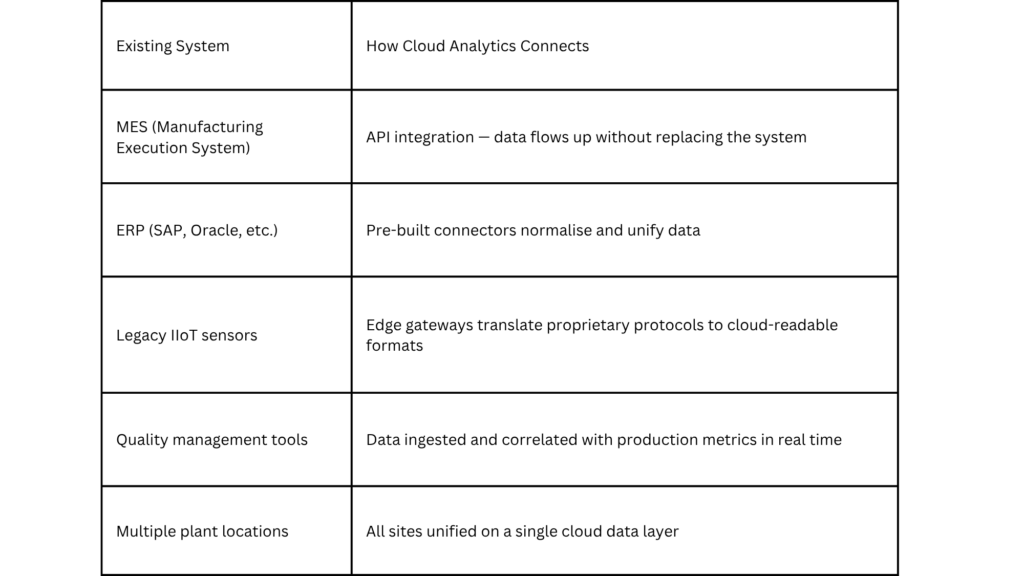
1. IT/OT Convergence: What It Means in Practice
Cloud analytics enables IT/OT convergence, the combination of operational technology data (shop floor machines and sensors) with information technology data (ERP, CRM, supply chain systems) into a single unified environment.
The practical outcome: your plant manager and your IT director are no longer looking at two different versions of operational reality. They share one source of truth — updated continuously, accessible from any location.
2. Edge-to-Cloud Architecture: Processing Data Where It Matters Most
Not every decision can wait for a round-trip to the cloud.
- Edge computing handles time-critical decisions at the machine level — quality control triggers on a high-speed line, real-time equipment alerts
- Cloud analytics handles historical modeling, cross-site visibility, trend analysis, and predictive intelligence
- The two work in tandem, edge for immediate action, cloud for strategic insight
This architecture also provides a clear, low-risk entry point: start with one production line, one defined problem, one success metric. Prove value at a contained scale, then extend across the facility.
The ROI Case: What Leadership Needs to Approve This Investment
For senior leadership evaluating cloud data analytics, the performance benchmarks are consistent across manufacturing deployments:
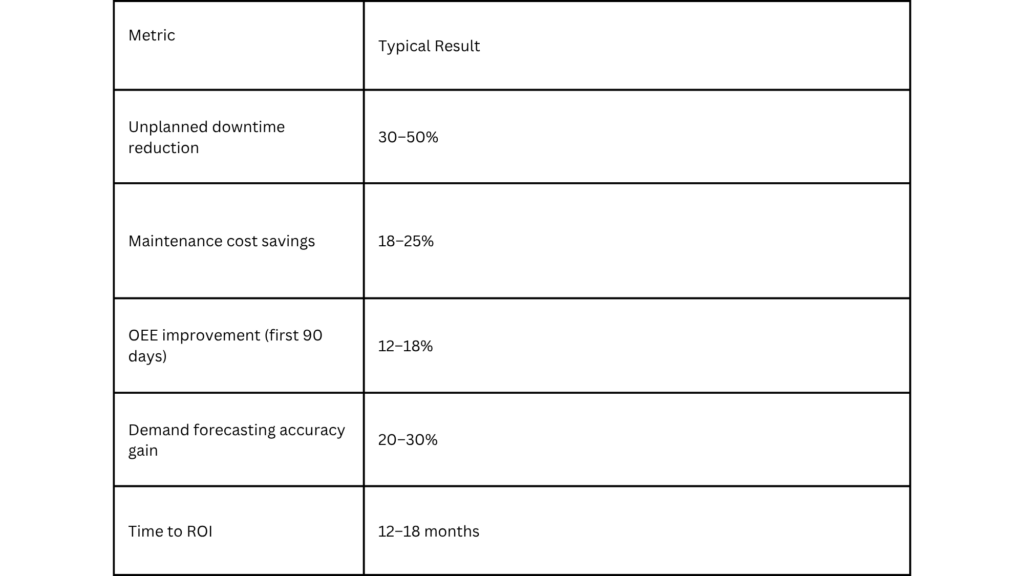
Want these benchmarks mapped to your production volume?
Request a FREE ROI assessment.
These efficiency gains translate directly into increased production capacity without additional capital expenditure on equipment, which is the metric that tends to move capital allocation decisions.
The Cost of Delay
The more important frame for leadership is not just the ROI calculation. It is the cost of operating without it.
Every month of decisions made on fragmented, delayed data is a month of:
- Maintenance spend is going to scheduled services that aren’t needed, while actual failures go undetected
- Production schedules built on stale demand signals — creating overstock or stockout exposure
- Quality issues caught at the customer, not the line
- IT resources spent manually reconciling systems that should connect automatically
In manufacturing, where profits are tight and competitive pressure is constant, the cost of each delay adds up. The ROI of cloud analytics is not the question. It is the price of the current model.
How to Start Without a Facility-Wide Transformation
A company-wide deployment is not the first step to take for quicker results. Rather do it for a single plant, warehouse, machines of single area, etc
A practical first-step framework:
- Identify your highest-cost operational gap: unplanned downtime, quality defect rates, scheduling inaccuracy, or cross-site visibility
- Select one production line or one data stream as the pilot scope
- Define one clear success metric: OEE improvement, downtime hours reduced, and maintenance cost per unit
- Run the pilot for 60–90 days and generate internal performance data
- Use the pilot results to build the business case for facility-wide expansion
The goal of the first step is not transformation. It is evidence — the internal proof that removes executive hesitation and gives your IT team a working integration model to scale.
Key Takeaways
- Data fragmentation is the real problem. Most manufacturers generate enough data. The barrier is connecting it across systems into a unified, real-time view.
- Cloud analytics is operational, not just technical. The outcomes — downtime reduction, demand accuracy, quality control — are business results, not IT features.
- Integration does not require rip-and-replace. Cloud analytics layers over your existing MES, ERP, and IIoT infrastructure via APIs and pre-built connectors.
- Start narrow. One line, one problem, one metric. Prove value at the pilot stage before scaling.
- The ROI case is well-established. 30–50% downtime reduction, 12–18 month payback, 12–18% OEE improvement in the first 90 days.
Find out where your operations are losing the most to fragmented data.
What Should You Do Next?
If you’re evaluating cloud analytics for your manufacturing operations, the smartest next step isn’t jumping into tools.
It’s understanding:
- Where your data gaps are
- Which use cases will deliver immediate ROI
- How to align IT and operations around a shared data strategy
Start with a focused assessment, not a full transformation.
Because the companies winning right now aren’t the ones with the most data.
They’re the ones who use it fastest and smartest.
If you’re looking to identify where your operations are losing efficiency and how cloud analytics can deliver measurable impact, Contact Infosprint Technologies
Frequently Asked Questions
Yes. Modern cloud analytics platforms use edge gateways and pre-built connectors to integrate with legacy equipment and proprietary protocols without requiring hardware replacement. Data from older machines is translated into a cloud-readable format and unified with data from newer systems on a single platform.
Most manufacturers see measurable ROI within 12–18 months for focused implementations. Pilots targeting high-cost pain points such as unplanned downtime or quality defect rates often generate evidence of value within the first 60–90 days.
Edge computing processes data locally at the machine level, enabling real-time decisions with minimal latency (e.g., immediate quality-control triggers). Cloud analytics processes data at scale across systems and sites, enabling predictive models, historical trend analysis, and cross-facility visibility. In a modern manufacturing architecture, both work together rather than as alternatives.
Start by identifying your single highest-cost operational gap, typically unplanned downtime, quality control failures, or demand forecasting inaccuracy. Pilot cloud analytics on one production line against that specific problem. Use the pilot results to build the business case for wider deployment.
Cloud data analytics addresses key operational issues in manufacturing, such as data silos and delayed decision-making. Unifying data from machines, ERP systems, and supply chains, it allows for real-time monitoring, predictive maintenance, improved product quality, and quicker responses to demand changes.
Related Blogs
Missiles, Models & a Pentagon Deal: March 2026
How Retailers Reduce Costs by 40–60% While Improving Customer Experience