

Less Tech Noise. More Strategic Insights
Join 5000+ Tech leaders & CISOs receiving our deep-dive insights.
How Retailers Reduce Costs by 40–60% While Improving Customer Experience


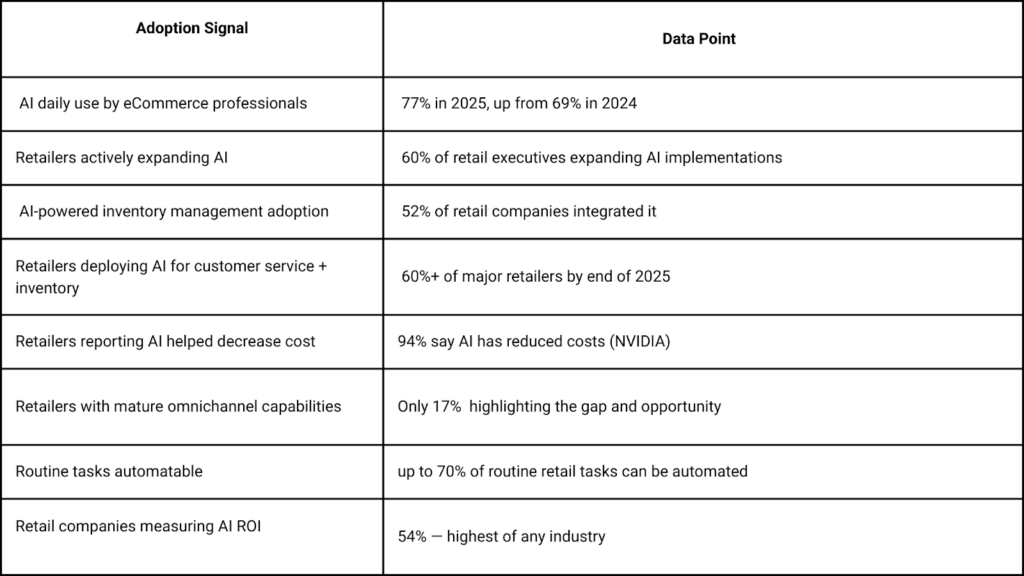
Up to 70% of retail tasks can be automated, yet only 17% of retailers have mature omnichannel operations.
That gap isn’t just inefficiency—it’s where revenue leaks, margins shrink, and customer experience breaks down.
“Retail doesn’t lose to competition—it loses to operational inefficiency.”
Today, 94% of retailers using AI report cost reductions, digital leaders operate with 31% lower fulfillment costs, and AI-driven companies are 1.8x more likely to achieve higher ROI. The difference isn’t effort—it’s systems.
This isn’t about innovation anymore. It’s about building operations that scale, adapt, and compete in real time. At Infosprint, we help retailers move from fragmented processes to intelligent systems—because in 2026, efficiency isn’t optional, it’s your competitive edge.
What AI & Automation Actually Mean in Retail
One of the biggest problems in this space is confusion.
“AI in retail” often gets reduced to chatbots or recommendation engines.
That’s a small piece of a much larger system.
This layered approach is what enables scalable transformation across modern retail environments. Explore how AI-driven retail digital transformation solutions are being implemented across omnichannel operations.
1. The Execution Layer: RPA (Robotic Process Automation)
This is where RPA becomes critical, handling structured workflows at scale. Many retailers are now leveraging UiPath RPA automation solutions for retail workflows to eliminate manual processing and improve speed.
RPA handles structured, repetitive tasks:
- Processing invoices
- Updating inventory records
- Managing returns workflows
- Syncing data across systems
Think of it as your digital workforce—fast, consistent, and error-free.
But on its own, RPA has limits. It follows rules. It doesn’t think.
2. The Intelligence Layer: AI (Machine Learning, NLP, Computer Vision)
This is where transformation actually happens.
AI introduces decision-making into your operations:
- Predicting demand across SKUs and locations
- Detecting fraud based on behavioral patterns
- Personalizing product recommendations in real time
- Understanding customer queries through natural language
Unlike rule-based systems, AI improves over time.
It adapts to patterns your team can’t manually track.
3. The Data Layer: IoT (Real-Time Inputs)
Retail has always struggled with one core issue: data latency.
By the time decisions are made, the data is already outdated.
IoT changes that by feeding live data into your systems:
- Shelf sensors detecting stock levels
- RFID tracking product movement
- Smart checkout captures transaction behavior
- Environmental sensors monitoring storage conditions
Now your AI isn’t working with yesterday’s data—it’s working in real time.
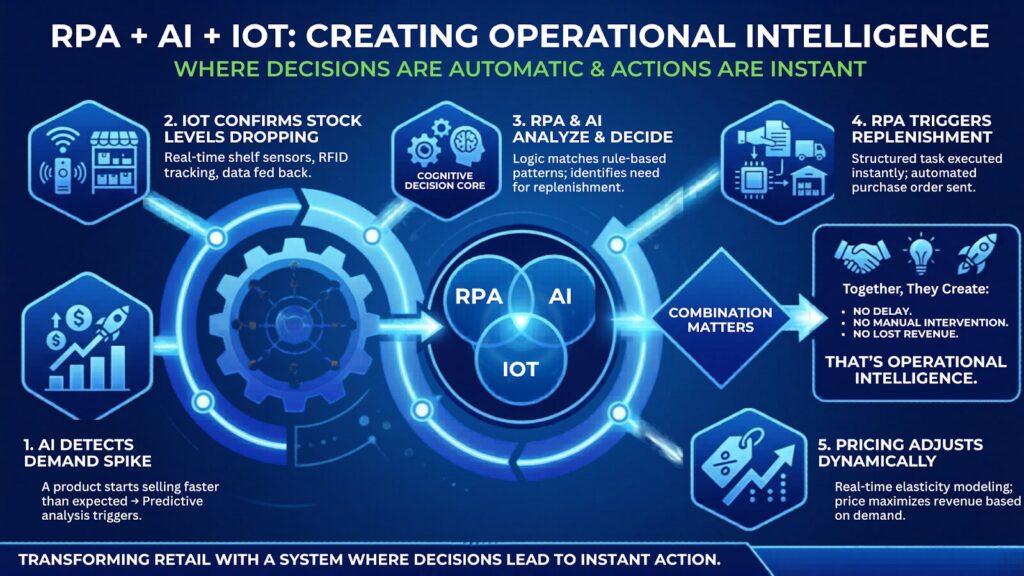
This is where automation starts delivering measurable impact at scale. For a deeper look at how this works in practice, explore how retail automation solutions are saving 50+ hours a week with RPA, AI, and IoT.
The 5 Operational Bottlenecks That AI Eliminates
If you strip retail operations down to their core, most inefficiencies fall into five categories.
Let’s break them down properly—not as concepts, but as real business problems.
1. Inventory Waste & Stockouts: The Margin Killer You Can’t See
Inventory is one of the largest investments a retailer makes, yet it’s also one of the least accurate.
The issue isn’t just overstocking or understocking—it’s misaligned inventory across locations and channels.
A product might sit idle in a warehouse while simultaneously being unavailable in a high-demand store or online channel. That disconnect creates two silent drains on profitability:
- Capital tied up in unsold stock
- Missed revenue from unavailable products
What makes this worse is the lack of real-time visibility. By the time teams identify the issue, the damage is already done—either through markdowns or lost customers.
2. Slow Fulfillment & Manual Workflows: The Hidden Scalability Ceiling
Retail operations are still heavily dependent on manual processes behind the scenes—order entry, invoice handling, returns processing, and constant data reconciliation.
These workflows may function well at a smaller scale, but as volume grows, they begin to slow everything down.
Delays increase. Errors become more frequent. Teams spend more time fixing issues instead of moving operations forward.
This creates a hidden ceiling on growth.
Not because demand isn’t there, but because operations can’t keep up efficiently.
3. Fraud & Revenue Leakage: The Loss You Don’t Fully See
Fraud in retail doesn’t always appear as a single large incident. It accumulates through smaller, harder-to-detect activities—payment fraud, return abuse, promotional misuse, and account takeovers.
Because many of these activities mimic legitimate behavior, they often go unnoticed until after the loss has occurred.
Even when detected, the response is usually reactive. Investigations take time, and by then, the financial impact has already been absorbed.
This makes fraud one of the most underestimated drains on retail profitability.
4. High Customer Service Costs: The Trade-Off Between Scale and Experience
Customer expectations have shifted toward immediacy—instant responses, always-on availability, and seamless support across channels.
But most retail support systems are still built around human capacity.
As customer volume increases, retailers face a difficult trade-off:
- Increase team size and operational costs
- Or maintain team size and accept slower response times
Neither option scales efficiently.
Over time, this leads to rising support costs, inconsistent service quality, and a customer experience that struggles to meet expectations.
5. Poor Demand Visibility: Operating One Step Behind Reality
Many retail decisions are still based on delayed or incomplete information—such as weekly reports, static dashboards, or historical trends.
By the time insights are available, the opportunity to act has often passed.
This creates a reactive operating model:
- Inventory decisions lag behind demand shifts
- Promotions are mistimed
- Staffing doesn’t align with actual traffic
Instead of anticipating demand, teams are constantly adjusting after the fact.
And in a fast-moving retail environment, being late is often the same as being wrong.
Deep Dive: 5 High-Impact AI Use Cases in Retail
AI and automation don’t solve retail challenges in theory—they solve them through specific, applied systems embedded across operations.
Each of the following use cases targets a core operational layer and delivers measurable impact when implemented correctly.
1. AI-Based Demand Forecasting
Once operational workflows are streamlined, the next step is improving decision accuracy—starting with demand forecasting.
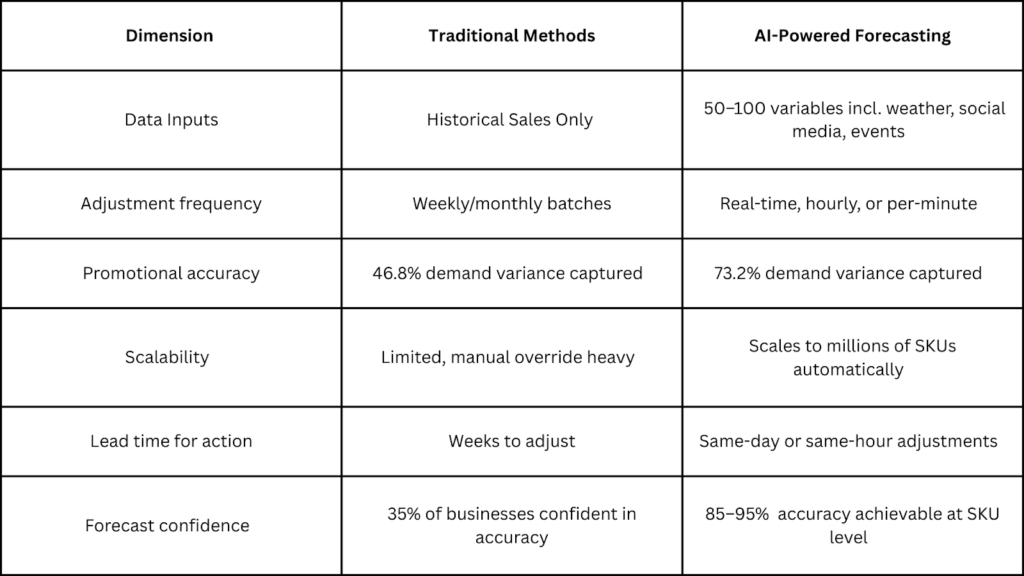
In contrast to conventional models that mostly rely on past data, AI-driven forecasting systems analyze multiple variables simultaneously and update continuously.
This allows retailers to move from static planning to dynamic forecasting.
In practice, this means:
- Demand is predicted at a granular level (SKU, store, channel)
- Forecasts adjust in real time as new data comes in
- Inventory planning aligns more closely with actual demand patterns
The impact is immediate and measurable:
- Reduced forecasting errors
- Fewer stockouts and excess inventory situations
- Greater confidence in planning and allocation decisions
What changes fundamentally is not just accuracy, but timing—decisions are made earlier, when they can still influence outcomes.
2. Retail Process Automation: Creating Self-Sustaining Workflows
When you go beyond just automating core functions and create a process that is completely self-sufficient through the utilization of AI, you begin to see how AI can not only create complete solutions but also connect the entire workflow, from start to finish, into one cohesive unit.
For example:
- Automated inventory-level detection will generate automatic restocking systems.
- Complete financial processes will be run with near-perfect accuracy via AI.
- Returns are assessed using computer vision, enabling faster decisions on refunds and restocking.
All three of these systems will not only eliminate manual intervention but also provide a solution where less oversight and interaction is required.
This creates a solution that is both more stable and predictable:
- Processes run continuously
- Errors are minimized
- Teams focus on optimization rather than execution
3. AI-Powered Fraud Detection: Real-Time Protection at Scale
Fraud detection is one of the first and most visible areas where AI has made a measurable impact. AI can now analyze behavior as it occurs. Instead of relying on predetermined rules to detect anomalies, fraud detection will occur in real time through analysis of consumer behavior. The retailers will be able to review and approve purchases before completing the sale, rather than being forced to wait until after the fact for investigation or follow-up.
AI can detect patterns across:
- Transactions
- User behavior
- Device usage
- Location data
The advantage here is speed and adaptability. Decisions happen in milliseconds, and models continuously learn from new patterns, making them more effective over time.
This results in:
- Faster identification of fraudulent activity
- Reduced false positives that affect genuine customers
- Lower investigation time for internal teams
At the same time, smoother and more secure transactions improve customer trust—especially at critical touchpoints like checkout.
4. Chatbots & Virtual Assistants: Redefining Customer Interaction at Scale
Customer experience is no longer limited by team size when AI is introduced into support systems. Modern conversational AI handles a large portion of customer interactions instantly, across multiple channels. These systems are designed to understand intent, not just keywords, which allows them to manage real-world conversations effectively.
They handle queries such as:
- Order tracking and updates
- Returns and refunds
- Product recommendations
- General support requests
More importantly, they operate continuously—without delays, without queues. The impact extends beyond support efficiency. By reducing friction during the customer journey, AI-driven interactions contribute directly to:
- Higher conversion rates
- Faster resolution times
- Improved customer satisfaction
Human agents remain part of the system—but they focus on complex, high-value interactions rather than repetitive queries.
5. Predictive Analytics for Retail Sales: Driving Growth Through Foresight
The final layer of AI in retail is predictive analytics—where data is used not just to understand performance, but to shape future outcomes.
By analyzing behavioral patterns, transaction data, and external signals, AI enables retailers to anticipate what customers are likely to do next.
This influences multiple areas of the business:
- Personalized offers based on customer behavior
- Dynamic pricing strategies aligned with demand
- Inventory positioning based on predicted sales velocity
- Staffing aligned with expected traffic patterns
The shift here is from reacting to performance → actively influencing it. Retailers leveraging predictive analytics often experience:
- Increased revenue through better targeting and personalization
- Higher conversion rates
- More efficient inventory utilization
But the real advantage is strategic. Decisions are no longer based on hindsight—they are driven by forward-looking insights, allowing retailers to act earlier and more effectively than competitors.
The Real Opportunity: Cost Reduction + Experience Growth
AI will not only lower the operation costs, but also improve the way the business operates as a whole. The fulfillment process will happen faster, the decision-making will be made with more information, and customers will receive a consistent customer experience across all channels through the application of AI.
Retailers who are taking advantage of AI today are already experiencing:
- Reduced operation costs
- Faster and more reliable fulfillment
- Increased customer experiences and conversions
Retailers who wait will continue to operate their businesses inefficiently using manual processes, and they will see increased costs due to manual processes and a reactionary approach to decision making.
AI and automation are no longer optional. They are the systems that will define which retailers scale—and which fall behind.
If you’re evaluating where to start, the next step is simple:
Schedule a free AI readiness assessment and identify your highest-impact opportunities.
Frequently Asked Questions
The reduction in costs is driven by automating repetitive tasks through an AI application as well as improving demand forecasting and reducing errors. As a result, AI allows retailers to become less reliant on people, reduce inventory waste, and streamline processes, enabling them to operate more rapidly and efficiently.
Some common examples include demand forecasting, inventory automation, fraud detection, chatbots for customer support, and predictive analytics. These all assist retailers in delivering improved customer satisfaction, reducing costs, increasing efficiency, and enhancing the overall experience within retail operations.
Retailers are leveraging AI and RPA to enable real-time tracking of inventory, instigate auto-replenishment for inventory, and optimize the supply chain. They are helping retailers to minimize stockouts, avoid excess inventory, and produce more accurate results for both warehouses and stores.
Data entry and other rule-based processes are automated through RPA workflows. AI provides the intelligence to rationalize data, forecast outcomes, and ultimately make decisions. When RPA and AI are used together, retailers can achieve full end-to-end automation of retail operations.
Chatbots are designed to provide rapid answers to customer questions, address frequently asked questions, and facilitate product searching. This leads to reduced wait periods for customers, By helping clients with the buying process, you may increase customer happiness and, eventually, conversion rates.
Related Blogs
Emerging AI & Automation Trends Shaping Business Operations in 2026

Sovereign Cloud: Why Data Sovereignty Is Becoming a Strategic Business Priority