
January 2026 Signals Every Business Leader Should Pay Attention


January didn’t arrive with a single defining technology headline.
Instead, it delivered a pattern that many enterprise leaders are still underestimating.
- A global brand began investigating a large-scale data exposure.
- A core enterprise platform rushed to patch an actively exploited vulnerability.
- AI systems moved another step closer to acting independently inside production environments, underscoring the need for leaders to stay vigilant and prepared.
Acknowledging that none of these developments is isolated helps enterprise leaders understand the systemic cybersecurity risks that require their confident strategic responses in 2026.
At Infosprint Technologies, we emphasize that month-end developments are indicators of shifting enterprise risk, urging leaders to proactively reassess strategies before signals turn into incidents, because it clarifies strategic focus.
Cybersecurity: Incidents Are No Longer Contained — They Cascade
1) Microsoft: Patch Velocity Becomes a Business Variable
In early January, Microsoft issued an emergency patch for an actively exploited vulnerability in widely used enterprise software. The urgency wasn’t unusual — the context was.
The affected platforms were deeply embedded across organizations, touching identity, productivity, and endpoint workflows. This wasn’t an edge-case exploit. It was a reminder that the most appealing attack vector is always the most fundamental tool.
What this reveals:
Security risk is no longer associated with esoteric systems. It is now focused on platforms that are relied on every day and are considered to be “handled.”
Why this matters
- Trusted platforms are now a source of systemic risk, not a foundation of safety
- The lag in patches is no longer a technical debt problem – it’s a window of vulnerability
- Distributed workforces expand vulnerability when patch consistency is not equivalent across regions and work roles
Key takeaways:
- Patch management needs to be considered from the perspective of risk response, not IT housekeeping
- The delay in deployment across regions, subsidiaries, and contractors is now a quantifiable risk exposure
- Organizations must now question which systems are “too standard to fail” – attackers already have
2) Nike: When a Brand Incident Exposes Ecosystem Risk
Later in January, Nike confirmed it was investigating a potential large-scale data breach following claims by a cybercrime group.
Beneath the headlines, the relevance is in what today’s breaches seek. Attackers are increasingly interested in design data, contracts with suppliers, internal systems, and operational insights, not only customer information.
What this reveals: Enterprise value is spread throughout partner ecosystems. When a node is breached, the others are exposed to risk.
Why this matters
- Enterprise value is increasingly external to core systems – in partners, suppliers, and shared data
- A breach of a large brand name can have contractual, operational, and reputational fallout
- Vendor breaches now require collective action, not passive observation
Key takeaways:
- Vendor risk programs must account for data interdependence, not just compliance checklists
- Organizations should identify which partners hold data that would materially affect operations if exposed
- Incident response planning must include downstream communication and contingency scenarios, not just internal remediation
3) The Evolving Threat Landscape: AI Changes the Economics of Attacks
In January, security researchers identified a new wave of AI-generated malware actively targeting crypto developers, highlighting how generative AI is now being used to accelerate malware creation, disguise malicious code, and evade traditional defenses.
While the immediate targets were developer communities, the broader signal is more important: attackers are no longer crafting attacks manually. They are industrializing them.
Phishing campaigns now adapt in near real time. Malware variants mutate faster than signature-based tools can keep up. Social engineering has become cheaper, more personalized, and harder to distinguish from legitimate activity.
This is no longer a future-facing concern. It is already reshaping incident response metrics inside enterprise security teams.
Why this matters
- Attackers can now iterate faster than traditional detection cycles
- Manual investigation models struggle under high-volume, low-signal attacks
- Time-to-detection becomes a more meaningful metric than absolute prevention
Key takeaways:
- Detection speed and response discipline now matter more than perfect prevention
- Security teams should identify where automation can compress response time without removing human accountability
- Metrics such as dwell time, containment speed, and escalation latency should be elevated to executive and board-level reporting
- Organizations should assume AI-assisted attacks as a baseline threat model, not an edge case
4) AI-Powered Security Partnerships: PwC and Google Cloud Signal a Shift
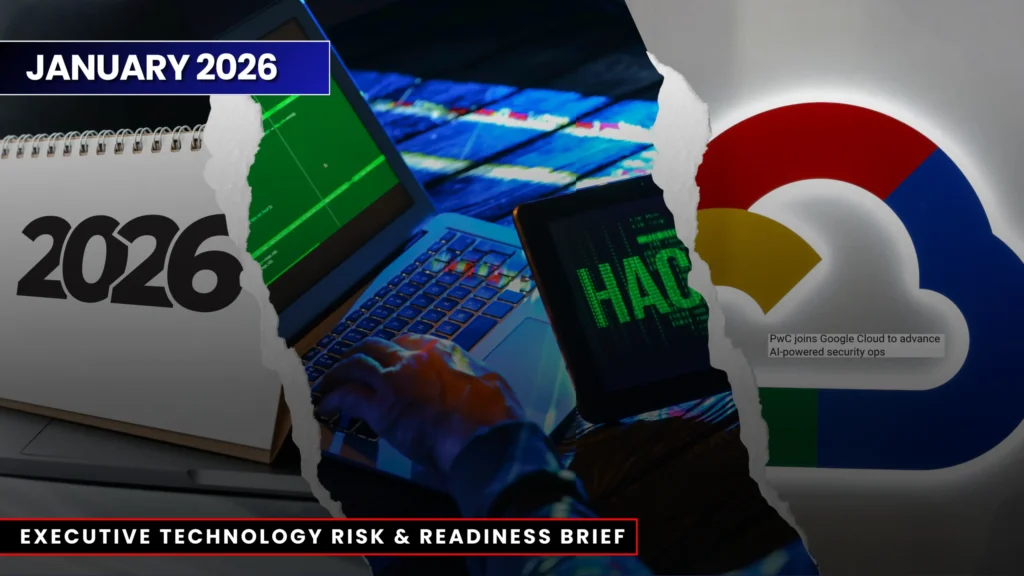
In January, PwC and Google Cloud expanded a $400 million collaboration to build AI-powered security operations centers (SOCs).
This was not positioned as a pilot or innovation lab. The emphasis was on integrated, production-grade security operations that combine cloud-scale analytics, automation, and advisory services.
The significance lies less in the dollar value and more in the intent: enterprises are no longer experimenting with AI in security — they are re-architecting how security operations function.
Why this matters:
- Leading enterprises are moving away from fragmented, tool-centric SOCs Security capability is being packaged as an operational platform, not a collection of alerts
- Partnerships between hyperscalers and advisory firms signal long-term commitment, not experimentation
Key takeaways:
- Reassess whether your SOC operates as an integrated system or a set of loosely connected tools
- Evaluate vendor strategies for depth of integration, not breadth of features
- Expect increasing pressure from boards and auditors for demonstrable SOC maturity, not tool count
- Security leadership should prepare for SOC transformation discussions at the executive level
Cloud: Hybrid Architectures Become Strategic, Not Transitional
Hybrid Cloud + AI Investment Signals a Maturity Shift January’s investment patterns clearly show that hybrid cloud is now a strategic choice rather than a transitional phase because it influences long-term architecture planning.
It is becoming the default architecture for organizations balancing:
- AI workload performance
- Data residency requirements
- Cost predictability
- Operational resilience
- Rather than chasing scale alone, leaders are designing for control and failure isolation.
Why this matters
- AI workloads increase pressure on centralized infrastructure.
- Regulatory expectations vary across Canada, Singapore, and the US.
- Dependency on a single cloud provider creates systemic risk.
B2B takeaway:
- Hybrid cloud is becoming a deliberate architectural choice, not a transition phase
- Leaders should reassess which workloads truly benefit from centralization — and which require isolation
- Cloud strategies must be evaluated against failure scenarios, not just performance benchmarks
AI & Automation: From Assistance to Authority
1) IBM: AI Demand Reflects Outcome Expectations
January earnings from IBM reinforced a trend that has been building quietly: enterprises are committing budget to AI-powered software that delivers operational results, not experimentation.
AI is no longer competing with other innovation initiatives. It is competing with cost optimization, risk reduction, and efficiency mandates.
Why this matters
- AI spending is now evaluated based on operational returns, rather than on the potential for innovation.
- Budget tolerance for experimental deployments is decreasing.
- Expectations for ownership and accountability regarding AI systems are becoming stricter.
Key takeaways:
- AI initiatives must clearly define where value is created or costs are reduced.
- Leaders should anticipate greater scrutiny on ROI and operational accountability.
- AI initiatives that can’t be linked to measurable outcomes will struggle to achieve scalability.
2) Autonomous Agents: Visibility Without Governance Creates Risk
January also brought increased visibility to autonomous AI agents, moving closer to real operational use. While promising, these systems introduce new governance challenges.
The primary risk is not model failure — it is unclear authority.
What this reveals:
Automation layered onto ambiguous processes amplifies dysfunction rather than eliminating it.
Why this matters
- Autonomy introduces risks in decision-making and execution.
- A lack of clear authority increases operational ambiguity.
- Fixing governance gaps becomes more challenging after deployment.
Key takeaways:
- Autonomy should only be introduced where process ownership is clear.
- Human override paths must be designed before deployment, not after incidents occur.
- Autonomous systems should be auditable by default rather than by exception.
What Enterprise Leaders Should Pressure-Test Now
When viewed together, January’s developments reveal a single underlying shift:
Enterprise technology is becoming more powerful — and less forgiving of ambiguity.
Security incidents affect ecosystems; cloud architectures must anticipate failures rather than strive for perfection. AI systems need defined boundaries, not blind trust. This focus isn’t on fear but on preparedness.
Before Q1 plans harden into long-term commitments, technology leaders should be asking:
- Where do we still depend on delayed patching or manual security processes?
- Which vendors pose hidden concentration or supply-chain risks?
- Where are we introducing autonomy without clearly defined authority and accountability?
- Do our cloud architectures degrade gracefully, or do they collapse all at once?
For organizations keen to learn from signals instead of incidents, this month has provided something valuable: direction.
If your team is evaluating how these shifts could affect your technology strategy, risk posture, or upcoming investments, a focused conversation can help clarify priorities before decisions harden into long-term commitments.
Frequently Asked Questions
January 2026 was a turning point in cybersecurity, with notable events exposing IT vulnerabilities, a huge data leak at a multinational company, the rise of malware created by artificial intelligence, and a rise in the use of AI-powered security measures in businesses throughout the globe.
The January 2026 cybersecurity attacks brought to light the necessity of risk preparation that goes beyond defensive perimeters. The significance of patch velocity, third-party risk management, and incident response was highlighted by exploited vulnerabilities and vendor breaches. Instead of focusing only on preventive security or compliance, businesses should now give priority on detection speed, containment, and ecosystem exposure in their risk planning.
Enterprise value is at danger from suppliers, partners, and shared infrastructure, according to January’s breach reports. It is clear that breach value encompasses not only consumer data but also contracts, operational data, and intellectual property. The most important lesson is that in order to handle possible partner failures, proactive vendor risk assessments, efficient incident communication, and backup plans are essential.
Due to the overwhelming need for AI-enabled platforms, the focus on autonomous systems and AI-driven software continued in January 2026. Discussions on governance and control, with an eye on which automation processes should function independently and where human oversight is required, were sparked by this move towards outcome-based adoption.
January 2026 saw hybrid cloud strategies more and more a product of design rather than necessity. With the growing requirements of AI workloads for performance, data sovereignty, and cost forecasting, businesses are finding a middle ground between scale and control.
The key changes challenging conventional thinking include security breaches exposing ecosystem vulnerabilities, the rapid pace of AI adoption surpassing governance techniques, and a shift in cloud strategies from scale to resilience. These factors will influence budget allocation, system architecture, supplier management, and responsibility assignment for self-directed systems in 2026.
Related Blogs
AI Health Kiosks: A Security and Compliance Perspective
Beyond ISO 27001: DPDP Compliance Gaps Your Audits Are Missing